Search This Blog

Showing posts with label Solar. Show all posts

Sunday, April 18, 2021

#JPMorgan $JPM Pledges $2.5 Trillion Towards #GreenEnergy, Sustainability Effort

JPMorgan (JPM) Embarks on $2.5 Trillion Climate, Sustainability Effort - Bloomberg
Solar Panels

JPMorgan Chase & Co. 10 Year Goal includes $1 trillion for "green 
solutions"  
In 2020, JPMorgan facilitated $220 billion of financing to drive action on climate change and sustainable development, including more than $55 billion toward green initiatives  
Citigroup Inc. said it would back $1 trillion of similar efforts by 2030.


JPMorgan, Citi Pledge Trillions Toward Climate, Sustainability

  • U.S. banks boost efforts to fight climate change amid pressure

JPMorgan Chase & Co. set a goal to finance $2.5 trillion in initiatives that combat climate change and advance sustainable development over the next 10 years, while Citigroup Inc. said it would back $1 trillion of similar efforts by 2030.

Combined with previous announcements by Bank of America Corp., the three largest U.S. lenders have all committed to backing more projects that advance a low-carbon economy amid calls by the White House for businesses to do more to curb pollution.

JPMorgan's commitment includes $1 trillion for projects that bolster cleaner energy sources, it said Thursday in a statement. The bank will also support developing countries as well as initiatives that advance economic inclusion. Citigroup said half its pledge will go toward environmental projects, including renewable energy, water conservation and sustainable agriculture. Much of the rest is aimed at education, affordable housing, gender equality and racial and ethnic diversity.

Eliminating emissions has become a major talking point for bank executives this year as the finance industry attracted greater scrutiny for funding the world's biggest emitters. Goldman Sachs Group Inc., Citigroup and Bank of America have all set net-zero greenhouse-gas emissions targets in their financing activities.

"Climate change and inequality are two of the critical issues of our time, and these new efforts will help create sustainable economic development that leads to a greener planet and critical investments in underserved communities," Jamie Dimon, JPMorgan's chief executive officer, said in the statement.

Still, JPMorgan remains the biggest funder of fossil-fuel companies globally, financing about $189 billion since the 2015 Paris climate agreement, according to data compiled by Bloomberg. Dimon wrote in his annual shareholder letter last week that "the solution is not as simple as walking away from fossil fuels."

JPMorgan said its commitment will also enable it to provide clients in the corporate and investment bank and commercial-banking businesses with centralized access to sustainability-focused financing, research and advisory s

Low-Carbon Transition

"It is important to set expectations around where we want to see our clients' emissions head over the next 10 years, but it's also really important that we support them in their low-carbon transition," Marisa Buchanan, JPMorgan's global head of sustainability, said in an interview. "That means coming to the table with capital."

In 2020, JPMorgan facilitated $220 billion of financing to drive action on climate change and sustainable development, including more than $55 billion toward green initiatives, according to the statement.

Read the whole piece on Bloomberg here:

https://www.bloomberg.com/news/articles/2021-04-15/jpmorgan-embarks-on-2-5-trillion-climate-sustainability-effort

Monday, August 31, 2020

#Chile wants to export as much green #hydrogen by 2050—$30bn worth—, as it does today #Copper.

Chile seeks to turn solar boom into green hydrogen bonanza
Financial Times 

"a green technology revolution has pushed the cost of producing solar power down 80 per cent, and renewables now make up 44 per cent of the mix in a nation no longer dependent on imported energy. 

"Chile is now hoping this will allow it to achieve a similar feat with green hydrogen, a clean alternative to fossil fuels that — unlike solar and wind energy — can be used at any time of day or night and in any weather conditions.

"Chile could be exporting $30bn of green hydrogen by 2050," said Juan Carlos Jobet, the country's energy minister. "That's how much copper we export today."

Read the whole article online here: https://www.ft.com/content/16481d72-1495-4b24-9c59-97ea9a856cc1

MasterEnergy


Monday, August 17, 2020

The bet is that #electricity will be the prime means of delivering #CleanEnergy in the future and will grow rapidly.” #Europe’s Big #Oil Companies Taking the Lead In Turning Electric

A floating solar installation in Britain, a project of BP’s joint venture with Lightsource.

Under pressure from governments and investors, industry leaders like BP and Shell are accelerating their production of cleaner energy.

From the NY Times:

Europe's Big Oil Companies Are Turning Electric


The Italian oil company Eni's Green Data Center. The chief executive of Eni said he wanted it to rely more on green energy.
Nadia Shira Cohen for The New York Times

This may turn out to be the year that oil giants, especially in Europe, started looking more like electric companies.

Late last month, Royal Dutch Shell won a deal to build a vast wind farm off the coast of the Netherlands. Earlier in the year, France's Total, which owns a battery maker, agreed to make several large investments in solar power in Spain and a wind farm off Scotland. Total also bought an electric and natural gas utility in Spain and is joining Shell and BP in expanding its electric vehicle charging business.

At the same time, the companies are ditching plans to drill more wells as they chop back capital budgets. Shell recently said it would delay new fields in the Gulf of Mexico and in the North Sea, while BP has promised not to hunt for oil in any new countries.

Prodded by governments and investors to address climate change concerns about their products, Europe's oil companies are accelerating their production of cleaner energy — usually electricity, sometimes hydrogen — and promoting natural gas, which they argue can be a cleaner transition fuel from coal and oil to renewables.

Friday, October 26, 2018

What do you want? #RenewableEnergy. When do you want it? Now!

Renewables are a public opinion juggernaut. Being against them is no longer an  option. The industry's best and only hope is to slow down the stampede a bit (and that's what they plan to try).

100 percent renewables is a wildly popular goal

The core of the industry's dilemma is captured in this slide (on the left is the industry perspective):

eei EEI

Utilities don't think it is wise or feasible to go 100 percent renewables. But the public loves it.
And I mean loves it. Check out these numbers from the opinion survey:


In our polarized age, here is something we almost all agree on: Renewable energy is awesome.
Here's the most striking slide in the presentation:

eei EEI

In case you don't feel like squinting, let me draw your attention to the fact that a majority of those surveyed (51 percent) believe that 100 percent renewables is a good idea even if it raises their energy bills by 30 percent.

The Pangea Advisors Blog: What do you want? #RenewableEnergy. When do you wa...: 100% renewable energy: the public wants it, and quick - Vox Renewables are a public opinion juggernaut. Being against them is no longer an option.

The Pangea Advisors Blog

Pangea on Twitter

Sunday, March 4, 2018

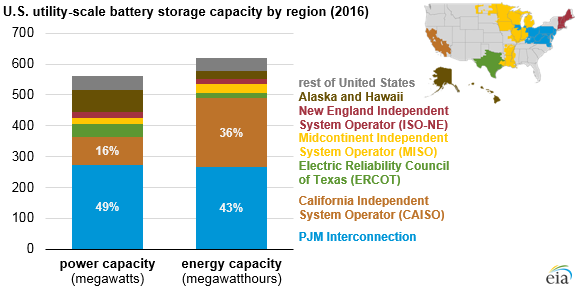
About ⅔ of utility-scale #batterystorage power capacity installed in 2016 in US is located in 2 electricity markets: #California (CAISO), & #PJMInterconnection, in all or parts of 13 eastern states & DC. @EIAgov

The design and application of utility-scale battery storage varies by region - Today in Energy - U.S. Energy Information Administration (EIA)
The design and application of utility-scale battery storage varies by region
February 28, 2018 U.S. utility-scale battery storage capacity by region, as explained in the article text

About two-thirds of utility-scale battery storage power capacity installed in 2016 in the United States is located in two electricity markets: the California Independent System Operator (CAISO), which covers much of California, and the PJM Interconnection, which covers all or parts of 13 eastern states and the District of Columbia. Utility-scale battery systems have been installed in these markets for different reasons. Utility-scale battery storage systems in California tend to serve energy-oriented applications, with smaller power capacities but longer discharge durations. Conversely, systems in PJM tend to serve power-oriented applications, with larger power capacities but shorter discharge durations.
Unlike most electricity generators, which can be characterized by their power capacity, batteries are characterized by two metrics: power capacity and energy capacity. Power capacity, measured in megawatts (MW), is the maximum instantaneous amount of power that can be produced on a continuous basis. Energy capacity, measured in megawatthours (MWh), is the total amount of energy that can be stored or discharged by the battery.

Friday, January 26, 2018

Grid cost parity is coming sooner than you think. How will #utilities react? #Renewables #batteries


Great report from @EY 

Utilities are on a countdown to reinvention

The energy industry has long known that radical transformation is coming. Revenues have been under pressure from the rise in renewables; in 2016, clean energy accounted for almost two-thirds of net new power capacity around the world.[1]

The maturing of renewable energy technologies, the proliferation of distributed energy resources, the falling cost of battery storage, and changing, more empowered consumer behavior are shifting how we produce, use, value and trade electricity.

Together these forces have put the energy sector on a path to three critical tipping points:

These dates will vary across global regions, because the trends driving change in the energy sector are different for different markets. But what is certain across all is that change is coming sooner than most of us previously expected. 
Grid cost parity is 2021 
  1. Tipping point 1 – when off-grid energy reaches cost and performance parity with grid-delivered energy – will arrive as early as 2021 in Oceania.
  2. Tipping point 2 – when electric vehicles (EVs) reach price and performance parity with combustion engine vehicles – will follow from 2025 across the globe. 
  3. And tipping point 3 – when the cost of transporting electricity exceeds the cost of generating and storing it locally – will hit the US Northeast region first in 2039.
See the full report here:

https://betterworkingworld.ey.com/digital/energycountdownclock


ShareThis

MasterEnergy News