Search This Blog

Showing posts with label Energy. Show all posts

Wednesday, February 17, 2021

#Texas’s #Blackout, Or When All The Inherent Problems Present In The US’s #Energy #Infrastructure Create The #PerfectStorm

In Texas's Black-Swan Blackout, Everything Went Wrong at Once - Bloomberg
Wouldn't say it was a #BlackSwan, as most of the problems could have been mitigated. 

"wind shutdowns accounted for 3.6 to 4.5 gigawatts -- or less than 13% -- of the 30 to 35 gigawatts of total outages, Ercot's Woodfin said. Gas produced 35% of the power in January.

"Natural gas played an outsize role in the disaster."

"Everyone wants to blame someone, so they blame Ercot"

In Texas's Black-Swan Blackout, Everything Went Wrong at Once

The finger-pointing began immediately: It was the frozen wind turbines that foolishly replaced traditional sources. No, fossil fuels were at fault. No, Texas's deregulated power market, unique in the country, had allowed companies to skimp on maintenance and upgrades.

As the hours ticked by and millions more were plunged into frozen darkness, a more sober reality emerged. The greatest forced blackout in U.S. history, as this event has almost certainly become, was the result of a systemic and multifaceted failure. There are no promises of when power will be restored and little likelihood that the episode won't be repeated in a corner of the country hard hit by climate change.

"This feels like a technical design failure," said Michael Webber, who founded the Webber Energy Group at the University of Texas at Austin and serves as chief science and technology officer at French utility Engie.

Power plants weren't fully weatherized, wiping out generation capacity. The ones that were still standing struggled to get enough fuel, with shale wells experiencing so-called freeze-offs. Many wind turbines stopped spinning. Texas, with a grid notoriously isolated from the rest of the U.S., was unable to call on neighboring states for help.

Still, as the pressure dropped last week and frigid air descended from the north, some saw what was coming and felt like they were witnessing a train crash.

Monday, August 31, 2020

#Chile wants to export as much green #hydrogen by 2050—$30bn worth—, as it does today #Copper.

Chile seeks to turn solar boom into green hydrogen bonanza
Financial Times 

"a green technology revolution has pushed the cost of producing solar power down 80 per cent, and renewables now make up 44 per cent of the mix in a nation no longer dependent on imported energy. 

"Chile is now hoping this will allow it to achieve a similar feat with green hydrogen, a clean alternative to fossil fuels that — unlike solar and wind energy — can be used at any time of day or night and in any weather conditions.

"Chile could be exporting $30bn of green hydrogen by 2050," said Juan Carlos Jobet, the country's energy minister. "That's how much copper we export today."

Read the whole article online here: https://www.ft.com/content/16481d72-1495-4b24-9c59-97ea9a856cc1

MasterEnergy


Monday, August 17, 2020

The bet is that #electricity will be the prime means of delivering #CleanEnergy in the future and will grow rapidly.” #Europe’s Big #Oil Companies Taking the Lead In Turning Electric

A floating solar installation in Britain, a project of BP’s joint venture with Lightsource.

Under pressure from governments and investors, industry leaders like BP and Shell are accelerating their production of cleaner energy.

From the NY Times:

Europe's Big Oil Companies Are Turning Electric


The Italian oil company Eni's Green Data Center. The chief executive of Eni said he wanted it to rely more on green energy.
Nadia Shira Cohen for The New York Times

This may turn out to be the year that oil giants, especially in Europe, started looking more like electric companies.

Late last month, Royal Dutch Shell won a deal to build a vast wind farm off the coast of the Netherlands. Earlier in the year, France's Total, which owns a battery maker, agreed to make several large investments in solar power in Spain and a wind farm off Scotland. Total also bought an electric and natural gas utility in Spain and is joining Shell and BP in expanding its electric vehicle charging business.

At the same time, the companies are ditching plans to drill more wells as they chop back capital budgets. Shell recently said it would delay new fields in the Gulf of Mexico and in the North Sea, while BP has promised not to hunt for oil in any new countries.

Prodded by governments and investors to address climate change concerns about their products, Europe's oil companies are accelerating their production of cleaner energy — usually electricity, sometimes hydrogen — and promoting natural gas, which they argue can be a cleaner transition fuel from coal and oil to renewables.

Monday, April 13, 2020

#OPEC+ #Oil Cuts Deal: @BMO Sees Best outcome of Prices Stabilizing between $20-30 as demand rebuilds


From BMO:

 CONCLUSION:. On the positive side, the agreement avoids a price collapse as it reduces the risk of filling up the global storage capacity completely and most importantly it ends the price war between Russia and Saudi Arabia.  Our research team expects the price of oil to remain between $20 and $30 through June while the market assesses the compliance and more importantly the potential rebound in demand at some point. As of this morning, the market reaction has been somewhat muted with Brent and WTI relatively unchanged.

1- TOTAL CUTS OF 13.4Mb/d if you had OPEC at 6.1M b/d, OPEC+ members mostly Russia at 3.6Mb/d and G-20 cuts monastery US/Canada/Brazil at 3.7Mb/d. The cuts are focused on the May-June period then they go down to 8M b/d for July-dec.

2- AVOID PRICE COLLAPSE DUE TO LACK OF STORAGE- Demand destruction is estimated at 17Mb/d for 2Q ( compared to a 13.4M b/d cut but an actual cut from the March level of ONLY 7Mb/d for OPEC+ members). So this means inventories will go up by about 984M barrels versus a total storage capacity including floating storage left of 1.2 billion barrels.

3- END OF THE PRICE WAR- probably the most positive is all this is the end of the price war between Russia and Saudi Arabia

4- CUTS BY THE G-20? US/Canada/Brazil but allows Norway are talking about cutting 3.7M b/d of supply but it is not very clear how. It will  be mostly through Strategic Petroleum Reserves ( SPR) purchases, shut-ins and natural declines.

5- THE TEXAS RAILROAD COMMISSION ( RRC) meets tomorrow Tuesday to discuss production cuts. Based on recent discussions we are doubtful a serious official cut will come out of the US as most of the large producers like Exxon and Chevron have come against it.

6- IDEAL PRICE- we continue to think that $40 WTI is where the Saudis and the Russians want to oil price which is enough to kill US Shale's economics while helping the local budgets of each closer to balance.
 Living on the Edge: Historic Deal With a Lot of Unknowns

Oil & Gas

IN Fact

Living on the Edge: Historic Deal With a Lot of Unknowns

Randy Ollenberger • Oil & Gas
(403) 515-1502
Phillip Jungwirth, CFA • Oil & Gas
(303) 436-1127

Bottom Line:

OPEC+ has reached an agreement to reduce production by 9.7 million b/d in May and June and roughly six million over the balance of the year. The G20 group acknowledged the need to stabilize oil markets and has reportedly agreed to reduce production by 3.7 million b/d. The OPEC+ cut (if adhered to) plus expected shut-in production due to low oil prices could be just enough to keep inventories from breaching capacity. We expect crude oil prices to trade in a $20-30/bbl range through May as the market waits to see if the production cuts materialize and are large enough to stave off disaster.

Key Points

OPEC+ capitulates. OPEC and its non-OPEC partners have agreed to reduce production by 9.7 million b/d in May and June and by roughly six million b/d for the remainder of the year. The baseline for the determination of production levels is October 2018 except for Saudi Arabia and Russia, which have baselines of 11 million b/d. The group will meet again on June 10 to determine if additional action is required.

No commitments but uneconomic shut-ins elsewhere. The broader G20 group did not explicitly commit to any reductions in supply but acknowledged the need to stabilize oil markets and has reportedly agreed to reduce supply by 3.7 million b/d through declines and shut-in of uneconomic production. The OPEC+ cuts are not contingent on commitments from the U.S. and others to reduce supply. We anticipate a drop in non-OPEC production of 1.8 million b/d in the second quarter and growing over the balance of the year due to the drop in activity levels.

Level of demand destruction unknown. We believe that global oil demand could be down more than 17 million b/d year over year in the second quarter to roughly 82 million b/d, which would represent the lowest level of demand since 2004. Taking the OPEC+ cuts into consideration we anticipate a year-over-year decline in production of 7 million to 92.8 million b/d, which implies a build of approximately 984 million barrels. We estimate remaining available global storage capacity (including floating storage) is roughly 1.2 billion barrels. While this means there could be adequate storage room there is not much room for error.

Pricing in uncertainty. We expect crude oil prices to remain relatively weak through April and May as the market assesses the risk that the level of demand destruction could be higher than expected, leading to the possibility that there is not enough storage available. We also expect regional dislocations where storage fills up leading to wider price differentials in some markets.

View Comment >


Nothing in this e-mail shall constitute a personal recommendation unless explicitly provided.

BMO Capital Markets archives and monitors outgoing and incoming e-mail. The contents of this email, including any attachments, are confidential to the intended recipient and any unauthorized use or disclosure is prohibited. If you are not the intended recipient, do not re-send, copy or use this e-mail. Please also contact the sender immediately and delete this e-mail in its entirety. Privilege is not waived by reason of mistaken delivery to you. This email may be produced at the request of regulators or in connection with litigation. BMO Capital Markets accepts no liability for any errors or omissions arising as a result of transmission. Unless otherwise stated, opinions expressed in this email are those of the author and are not endorsed by BMO Capital Markets.

This message does not create or change any contract.

This email has been sent from Bank of Montreal Europe plc (Registered No. 255687), which operates under the trade name of "BMO Capital Markets" and is registered in Ireland with its registered address as 6th Floor, 2 Harbourmaster Place, IFSC, Dublin 1. Bank of Montreal Europe plc is authorised and regulated by the Central Bank of Ireland.

Thursday, January 2, 2020

#EastMed #NatGas #Pipeline Deal to be Signed by #Israel, #Cyprus, #Greece, amid #Turkey's sabrerattling #OOTT


Image result for east med subsea pipeline image
Image result for subsea pipeline image

1,900-kilometer (1,181 miles) Eastern Mediterranean natural gas pipeline will connect recently discovered gas fields in the eastern Mediterranean basin with European markets through Greece and Italy.


Cyprus President Anastasiades, Greek PM Mitsotakis and Israeli PM Netanyahu will on Thursday sign an accord for the construction of the long awaited pipeline. Italian Prime Minister Giuseppe Conte is set to sign the agreement at a later date.

The project is being developed by IGI Poseidon SA, a joint venture of Greece’s state-owned supplier Depa SA and Edison SpA.

The European Union has said it supports the project because it will help diversify its gas supplies and boost energy security.

U.S. Secretary of State Michael Pompeo also underlined American backing for the pipeline when he attended a Cyprus-Greece-Israel trilateral summit in Jerusalem in March.

Greece's Depa also signed on Jan. 2 with Energean Oil & Gas Plc a letter of intent for the potential sale and purchase of 2 billion cubic meters of natural gas per year from Energean’s fields offshore Israel, an important step for the project’s commercial viability and its realization.

Thursday, October 24, 2019

Sen. Warren’s #Energy Plan Will Kill the #Oil Industry--not just #Fracking

 
If frack­ing were banned-as Sen. Warren is calling for- nat­ural gas prices in the U.S. would jump to some­where be­tween $9 and $15, up from $2.32 per mil­lion BTU on Fri­day, Energy Investment Bank Tu­dor Pick­er­ing es­ti­mates.

Oil would rise to the $80-to-$85 range and could risk shoot­ing to $150 dur­ing mar­ket shocks.


Read the whole story on The Wall Street Journal: Prospect of President Warren Spooks Energy Investors


bit.ly/MasterEnergyBlog


Thursday, March 28, 2019

#LNG Grows for Trading Houses From @Gunvor to @Trafigura, @Glencore - Bloomberg

LNG is enjoying more rapid growth with about $150 billion in revenue last year, according to McKinsey Energy Insights. By next year, LNG volumes will be more than triple what they were at the start of the century, making it the quickest-growing segment of the fossil-fuel industry, according to Shell.

Commodity Traders Turn to LNG as Big Oil Profits Prove Elusive

Gunvor, Vitol and Trafigura are doing for natural gas what they did in the oil market in the 1970s.
Updated on


With margins narrowing in the crude oil business, some of the world's biggest commodity trading houses are helping to reshape the energy industry with a drive into liquefied natural gas.
Gunvor Group Ltd., Trafigura Group Pte. Ltd. and Vitol SA have moved a step beyond trading LNG, investing in ships and terminals handling the fuel. That's accelerating the growth of the industry, moving more gas that traditionally has flowed through pipelines onto ocean-going tankers chilled to minus 162 degrees Celsius (minus 260 degrees Fahrenheit).
Those houses in the 1970s broke away from Big Oil's long-term contracts and created a market where cargoes change hands in the blink of an eye. Now they're turning their attention to LNG, where spot trading is rapidly expanding. The result is handing utilities from Centrica Plc to RWE AG more flexibility to buy gas, encouraging them to make the leap away from more polluting coal.
"It looks like a much younger crude oil market,'' Russell Hardy, chief executive officer of Vitol, said in an interview in Lausanne, Switzerland. "It is an area that can grow and that is a positive for us.''

A Boom for LNG

Volumes by the end of this decade will at least triple since 2000.


The top three commodity trading houses active in LNG have more than doubled their delivered volumes over the past two years and took almost 9 percent of the global trade in 2018, according to data compiled by Bloomberg. Royal Dutch Shell Plc remains the industry leader with 22 percent and stakes in LNG plants and import terminals.
Other traders such as Glencore Plc and Koch Supply & Trading LP also are building expertise or looking to expand in LNG. Most trading houses set up their desks earlier this decade, while Vitol started back in 2005.

Trading Houses in LNG

Three largest commodity traders have boosted volumes in past few years.

Sunday, January 27, 2019

2019 Electric Vehicles #EV’s Sales expected to go up by “only” 40%

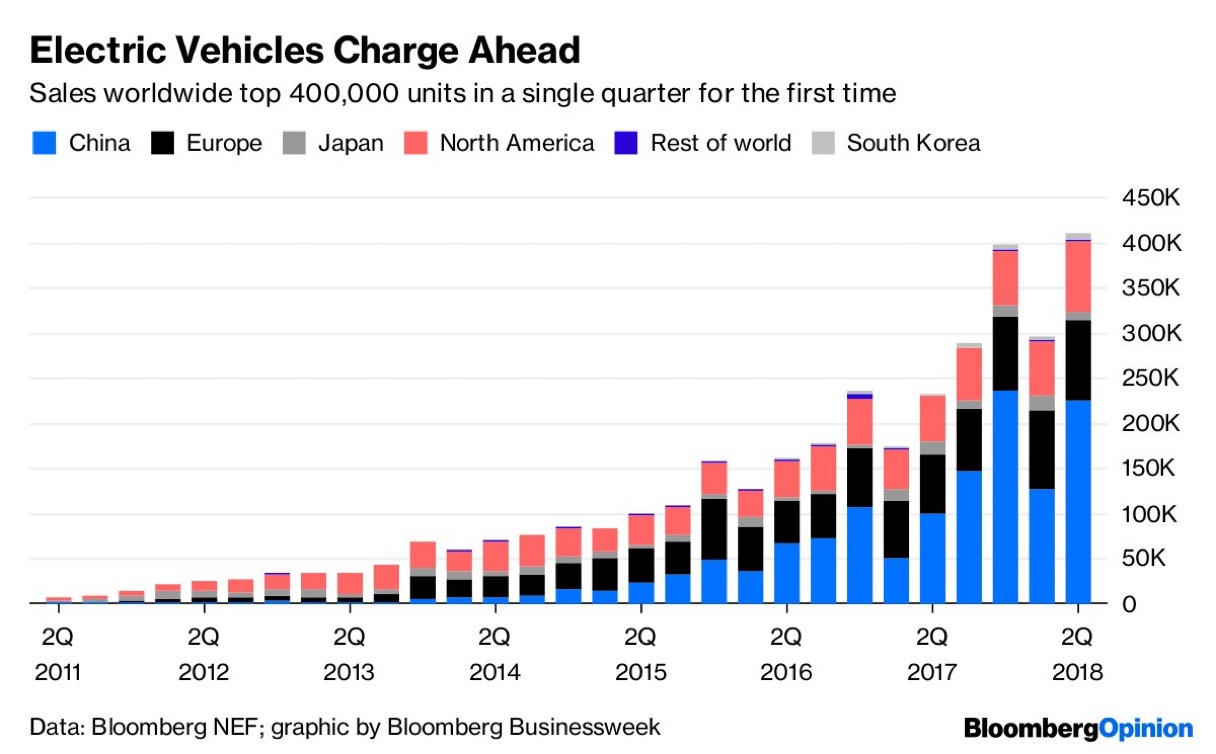
Electric vehicle sales are Charging Ahead
In 2019 Electric vehicle sales are expected to go up by “only” 40%

There are now almost 5 million passenger electric vehicles on the road globally (over 5 million including buses and other commercial vehicles). We expect another 2.6 million to be sold in 2019. This will represent around a 40% growth rate, down from the 70% growth rate in 2018. China will again lead, with some 1.5 million of those sales, representing around 57% of the global market.

Friday, October 26, 2018

What do you want? #RenewableEnergy. When do you want it? Now!

Renewables are a public opinion juggernaut. Being against them is no longer an  option. The industry's best and only hope is to slow down the stampede a bit (and that's what they plan to try).

100 percent renewables is a wildly popular goal

The core of the industry's dilemma is captured in this slide (on the left is the industry perspective):

eei EEI

Utilities don't think it is wise or feasible to go 100 percent renewables. But the public loves it.
And I mean loves it. Check out these numbers from the opinion survey:


In our polarized age, here is something we almost all agree on: Renewable energy is awesome.
Here's the most striking slide in the presentation:

eei EEI

In case you don't feel like squinting, let me draw your attention to the fact that a majority of those surveyed (51 percent) believe that 100 percent renewables is a good idea even if it raises their energy bills by 30 percent.

The Pangea Advisors Blog: What do you want? #RenewableEnergy. When do you wa...: 100% renewable energy: the public wants it, and quick - Vox Renewables are a public opinion juggernaut. Being against them is no longer an option.

The Pangea Advisors Blog

Pangea on Twitter

Thursday, March 22, 2018

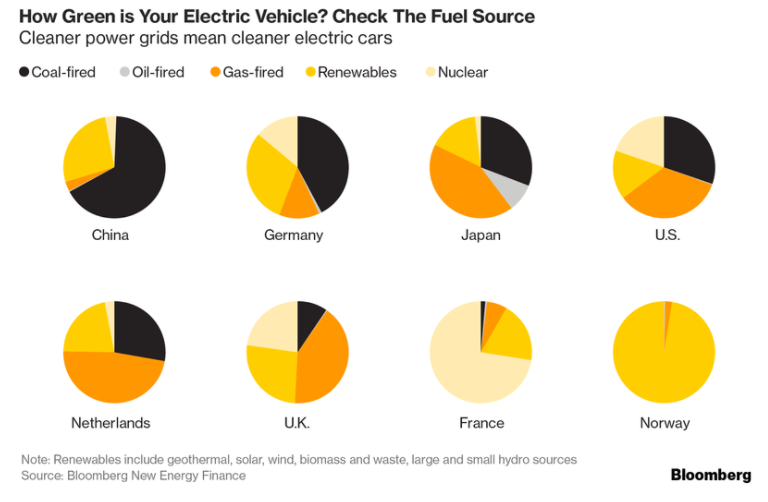
How “Green” is your #EV? Depends, says @WEF

The surprising truth behind the world's electric cars | World Economic Forum
Though electric cars are greener than conventional ones, much of their power still comes from coal.


The surprising truth behind the world's electric cars


Baojun E100 all-electric battery cars are seen while they are being charged in the parking lot in front of a Baojun NEV Experience Center store in Liuzhou, Guangxi Zhuang Autonomous Region, China, November 8, 2017. Picture taken November 8, 2017. REUTERS/Norihiko Shirouzu
Image: REUTERS/Norihiko Shirouzu

The production and sale of electric vehicles accelerated in 2016, with two million cars manufactured and over 750,000 sold globally, according to the International Energy Agency's (IEA) 2017 Global Electric Vehicle report.
And the market is expected to boom further in the coming years. The report predicts electric car stocks will range from between nine million and 20 million by 2020 and between 40 million and 70 million by 2025. Countries around the world are also attempting to ban the sale of petrol and diesel cars, and are encouraging motorists to go green.
However, electric vehicles are not emissions-free. While these vehicles obviously run on electricity, that electricity typically comes from a mix of emissions-intensive fossil fuels, nuclear energy, and power from renewables. That is, unless you live in country like Norway, which generates virtually all of its electricity from hydropower. But Norway is the exception rather than the rule.


ShareThis

MasterEnergy News