Search This Blog

Showing posts with label Nat Gas. Show all posts

Thursday, June 15, 2023

#Venezuela looks to #Gas in Long-Shot Bid to Revive its Economy


Venezuela wastes more gas via flaring and leaks than the UK produces in an average year

The ambitions make economic sense — there's robust demand from European nations looking to replace Russian supplies, and Venezuela wastes more gas via flaring and leaks than the UK produces in an average year — some $1 billion of the fuel annually. Exports could provide precious dollars for an economy that's shrunk by two-thirds since 2013 amid a currency collapse.

The moves also would be an incredibly difficult undertaking in a country where major energy companies have seen billions of dollars of investments expropriated without compensation,

Thursday, January 19, 2023

#Mexico's #Pemex destroyed resources worth $342 million from two top fields

Pemex burns one of Mexico's largest gas deposits as regulator circles, in Tierra Blanca

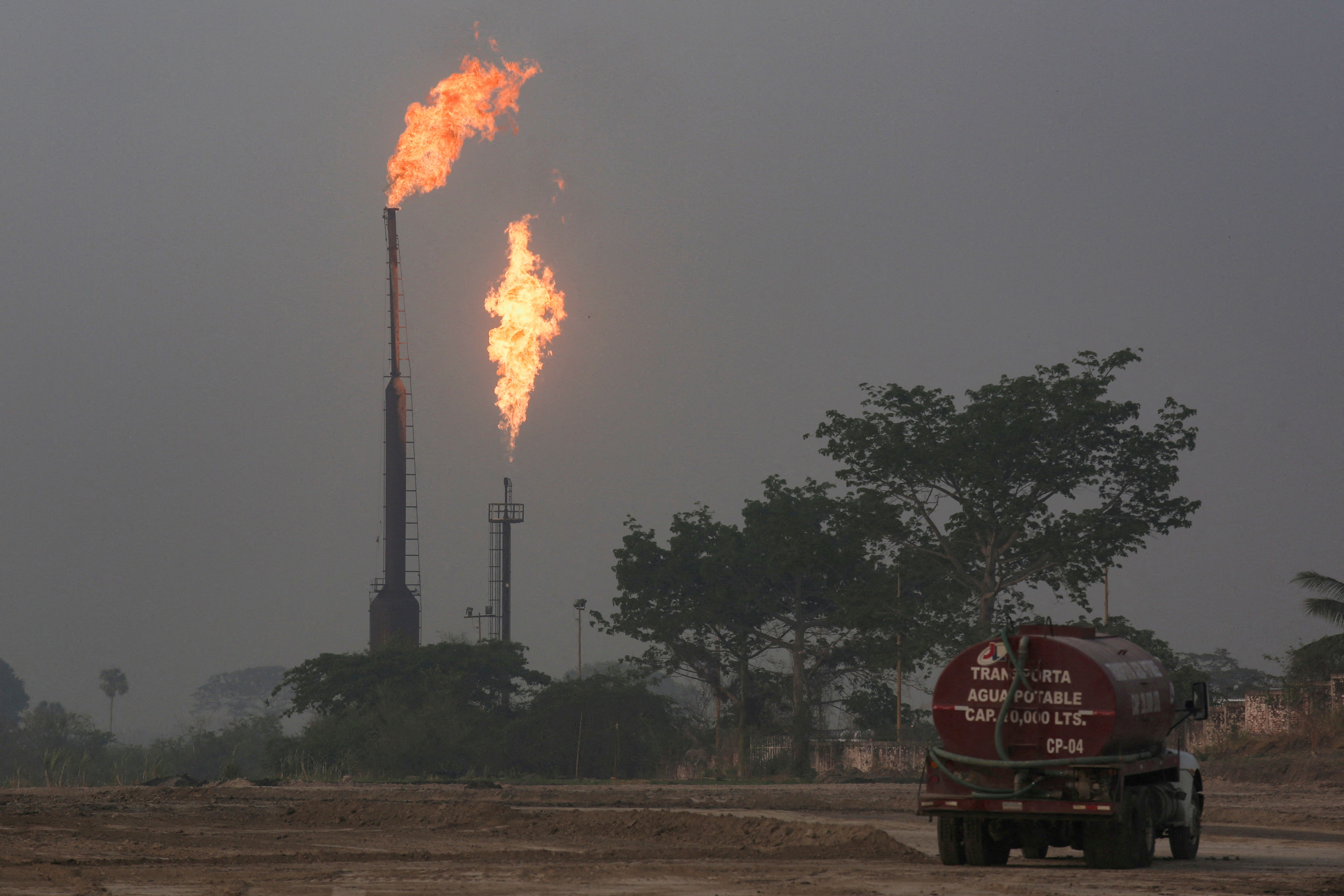
[1/2] Gas is flared at the state energy company Petroleos Mexicanos (Pemex) Perdiz Plant, which is unable to process the vast volumes of gas sent from the Ixachi field, outside of Tierra Blanca, Mexico May 4, 2022. REUTERS/Quetzalli Nicte-Ha/File Photo

Exclusive: Mexico's Pemex destroyed resources worth $342 million from two top fields

January 18, 202310:31 PM GMT+1

MEXICO CITY, Jan 18 (Reuters) - Mexican state oil company Pemex illegally burnt off hydrocarbon resources worth more than $342 million in the three years up to August 2022 at two of its most important new fields, internal documents from the country's oil regulator showed.

The three documents, produced by the regulator and dated August 2022, detail how Pemex (PEMX.UL) destroyed resources worth $275 million from the Ixachi field in three years and $67 million from the Quesqui field in two years.

Wednesday, April 20, 2022

#Africa's #Oil & #Gas Comes to #Italy’s Rescue—Will the rest of #Europe be left out?

“Diversification is possible and feasible relatively quickly, shorter than we imagined just a month ago.”

- Mario Draghi, April 17, 2022, in an interview with Corriere della Sera

Italy currently gets about 40% of its gas from Russia, and Draghi has acted quickly to try to replace that supply with flows from elsewhere since President Vladimir Putin invaded Ukraine in February.

With Eni already present in more than a dozen countries in Africa, the continent is an attractive option for Italy.

Monday, October 18, 2021

#GreenEnergy’s First Big #Energy Shock

The first big energy shock of the green era | The Economist

The Transition to #Renewables' Bumpy Road Ahead

Since May the price of a basket of oil, coal and gas has soared by 95%. 

- Britain, host of the COP26 summit, has turned its coal-fired power stations back on

- Vladimir Putin just reminded Europe that its supply of fuel relies on Russian goodwill.

- US Gas prices have hit $3 a gallon

-  Blackouts have engulfed China and India.  

Monday, March 9, 2020

#Oil: Energy companies feel the pain of #Saudi Arabia’s price war

A graphic with no description
Energy companies feel the pain of Saudi Arabia's price war
'This is the financial crisis for oil — except the producers are not too big to fail'

From the shale fields of Texas to deepwater projects in the North Sea, the price war launched by Russia and Saudi Arabia sent shockwaves across the entire energy industry and triggered the biggest sell-off since the global financial crisis.  

It has left some companies searching for strategies to protect profits and keep paying dividends. Others are fighting for survival. 

"The price collapse could be the trigger for a new phase of deep industry restructuring — one that rivals the changes seen in the late-1990s," said Tom Ellacott of the consultancy Wood Mackenzie. "Sustained prices below $40 a barrel would trigger a new wave of brutal cost-cutting. More highly-leveraged players will be forced to make the deepest cuts to stave off bankruptcy." 

Nowhere is that more true than in the shale industry, which helped end US dependence on Middle Eastern oil.


______________________________
MasterEnergy
@MasterEnergyRSS


Thursday, January 2, 2020

#EastMed #NatGas #Pipeline Deal to be Signed by #Israel, #Cyprus, #Greece, amid #Turkey's sabrerattling #OOTT


Image result for east med subsea pipeline image
Image result for subsea pipeline image

1,900-kilometer (1,181 miles) Eastern Mediterranean natural gas pipeline will connect recently discovered gas fields in the eastern Mediterranean basin with European markets through Greece and Italy.


Cyprus President Anastasiades, Greek PM Mitsotakis and Israeli PM Netanyahu will on Thursday sign an accord for the construction of the long awaited pipeline. Italian Prime Minister Giuseppe Conte is set to sign the agreement at a later date.

The project is being developed by IGI Poseidon SA, a joint venture of Greece’s state-owned supplier Depa SA and Edison SpA.

The European Union has said it supports the project because it will help diversify its gas supplies and boost energy security.

U.S. Secretary of State Michael Pompeo also underlined American backing for the pipeline when he attended a Cyprus-Greece-Israel trilateral summit in Jerusalem in March.

Greece's Depa also signed on Jan. 2 with Energean Oil & Gas Plc a letter of intent for the potential sale and purchase of 2 billion cubic meters of natural gas per year from Energean’s fields offshore Israel, an important step for the project’s commercial viability and its realization.

Thursday, October 24, 2019

Sen. Warren’s #Energy Plan Will Kill the #Oil Industry--not just #Fracking

 
If frack­ing were banned-as Sen. Warren is calling for- nat­ural gas prices in the U.S. would jump to some­where be­tween $9 and $15, up from $2.32 per mil­lion BTU on Fri­day, Energy Investment Bank Tu­dor Pick­er­ing es­ti­mates.

Oil would rise to the $80-to-$85 range and could risk shoot­ing to $150 dur­ing mar­ket shocks.


Read the whole story on The Wall Street Journal: Prospect of President Warren Spooks Energy Investors


bit.ly/MasterEnergyBlog


Thursday, March 28, 2019

#LNG Grows for Trading Houses From @Gunvor to @Trafigura, @Glencore - Bloomberg

LNG is enjoying more rapid growth with about $150 billion in revenue last year, according to McKinsey Energy Insights. By next year, LNG volumes will be more than triple what they were at the start of the century, making it the quickest-growing segment of the fossil-fuel industry, according to Shell.

Commodity Traders Turn to LNG as Big Oil Profits Prove Elusive

Gunvor, Vitol and Trafigura are doing for natural gas what they did in the oil market in the 1970s.
Updated on


With margins narrowing in the crude oil business, some of the world's biggest commodity trading houses are helping to reshape the energy industry with a drive into liquefied natural gas.
Gunvor Group Ltd., Trafigura Group Pte. Ltd. and Vitol SA have moved a step beyond trading LNG, investing in ships and terminals handling the fuel. That's accelerating the growth of the industry, moving more gas that traditionally has flowed through pipelines onto ocean-going tankers chilled to minus 162 degrees Celsius (minus 260 degrees Fahrenheit).
Those houses in the 1970s broke away from Big Oil's long-term contracts and created a market where cargoes change hands in the blink of an eye. Now they're turning their attention to LNG, where spot trading is rapidly expanding. The result is handing utilities from Centrica Plc to RWE AG more flexibility to buy gas, encouraging them to make the leap away from more polluting coal.
"It looks like a much younger crude oil market,'' Russell Hardy, chief executive officer of Vitol, said in an interview in Lausanne, Switzerland. "It is an area that can grow and that is a positive for us.''

A Boom for LNG

Volumes by the end of this decade will at least triple since 2000.


The top three commodity trading houses active in LNG have more than doubled their delivered volumes over the past two years and took almost 9 percent of the global trade in 2018, according to data compiled by Bloomberg. Royal Dutch Shell Plc remains the industry leader with 22 percent and stakes in LNG plants and import terminals.
Other traders such as Glencore Plc and Koch Supply & Trading LP also are building expertise or looking to expand in LNG. Most trading houses set up their desks earlier this decade, while Vitol started back in 2005.

Trading Houses in LNG

Three largest commodity traders have boosted volumes in past few years.

Monday, March 18, 2019

#Israel: @ExxonMobil Mulls an Offshore Bid for #Oil & #Gas blocks


Israel: ExxonMobil Mulls an Offshore Bid, Signaling a Shift in the Middle East Business Climate


4 mins read
(Stratfor)

The Big Picture
To say that Israeli-Arab ties have been contentious may be an understatement, but now those ties are beginning to show signs of subtle improvement, even if a full normalization remains far off. But even the current improvements will have business consequences, with opportunities increasing since companies may no longer face Gulf Arab economic retaliation for investing heavily in Israel. ExxonMobil may be on the verge of putting the new reality on display. 

What Happened

ExxonMobil is reportedly exploring whether to bid on blocks in Israel's ongoing second offshore bidding round. The firm, which has held discussions with Israeli Energy Minister Yuval Steinitz regarding a possible bid, has until March 28 to submit a letter of interest and documentation to prequalify as an operator for a block. (Whether it has already done so remains unclear.) ExxonMobil would then have until June 17 to submit a bid on any of the 19 available blocks. Should it win in July, the company would become the first oil and gas supermajor to enter Israel's oil and gas sector.

What It Means

ExxonMobil will not take the decision to invest in Israel's oil and gas sector lightly. Western companies – from the oil and gas sector and others – have long had to balance their relationship with Israel against their relationship with Israel's Arab neighbors, particularly Gulf countries like Bahrain, the United Arab Emirates, Kuwait and, of course, Saudi Arabia. Western energy companies have feared that investing in Israel would limit investment opportunities in much larger, more lucrative Arab markets.

ShareThis

MasterEnergy News