On Wednesday night, the US Department of the Treasury's Office of Foreign Assets Control hit Russia's two largest oil exporters, Rosneft PJSC and Lukoil PJSC, with sanctions. The move raises the stakes for buyers of their barrels, principally refiners in China, India and Turkey.
Rosneft PJSC and Lukoil PJSC, together with Surgutneftegas PJSC and Gazprom Neft PJSC, blacklisted in January, accounted for almost 70% of Russia's crude exports — around 3.1 million barrels a day — in the first half of the year.
If just half the Russian barrels covered by sanctions are curtailed, that could push the global oil market next year from a surplus of 700,000 barrels a day into a deficit, according to Bloomberg calculations using forecasts from the Organization of the Petroleum Exporting Countries.
Yamani served as Saudi Arabia's Oil Minister from 1962 until 1986, when he was dismissed by Saudi King Fahd over differing opinions on the Kingdom's oil policies.
When Yamani began his role as oil minister in 1962, the United States was the leading oil producer, with Saudi Arabia producing less than 2 million barrels per day. And Exxon and Chevron had control of most of the oil in Saudi Arabia. But that quickly changed as Saudi Arabia moved to nationalize its oil industry. Saudi Arabia's oil production quickly reached 10 million bpd during Yamani's tenure.
CONCLUSION:. On the positive side, the agreement avoids a price collapse as it reduces the risk of filling up the global storage capacity completely and most importantly it ends the price war between Russia and Saudi Arabia. Our research team expects the price of oil to remain between $20 and $30 through June while the market assesses the compliance and more importantly the potential rebound in demand at some point. As of this morning, the market reaction has been somewhat muted with Brent and WTI relatively unchanged.
1- TOTAL CUTS OF 13.4Mb/d if you had OPEC at 6.1M b/d, OPEC+ members mostly Russia at 3.6Mb/d and G-20 cuts monastery US/Canada/Brazil at 3.7Mb/d. The cuts are focused on the May-June period then they go down to 8M b/d for July-dec.
2- AVOID PRICE COLLAPSE DUE TO LACK OF STORAGE- Demand destruction is estimated at 17Mb/d for 2Q ( compared to a 13.4M b/d cut but an actual cut from the March level of ONLY 7Mb/d for OPEC+ members). So this means inventories will go up by about 984M barrels versus a total storage capacity including floating storage left of 1.2 billion barrels.
3- END OF THE PRICE WAR- probably the most positive is all this is the end of the price war between Russia and Saudi Arabia
4- CUTS BY THE G-20? US/Canada/Brazil but allows Norway are talking about cutting 3.7M b/d of supply but it is not very clear how. It will be mostly through Strategic Petroleum Reserves ( SPR) purchases, shut-ins and natural declines.
5- THE TEXAS RAILROAD COMMISSION ( RRC) meets tomorrow Tuesday to discuss production cuts. Based on recent discussions we are doubtful a serious official cut will come out of the US as most of the large producers like Exxon and Chevron have come against it.
6- IDEAL PRICE- we continue to think that $40 WTI is where the Saudis and the Russians want to oil price which is enough to kill US Shale's economics while helping the local budgets of each closer to balance.
Living on the Edge: Historic Deal With a Lot of Unknowns
Randy Ollenberger • Oil & Gas (403) 515-1502 Phillip Jungwirth, CFA • Oil & Gas (303) 436-1127
Bottom Line:
OPEC+ has reached an agreement to reduce production by 9.7 million b/d in May and June and roughly six million over the balance of the year. The G20 group acknowledged the need to stabilize oil markets and has reportedly agreed to reduce production by 3.7 million b/d. The OPEC+ cut (if adhered to) plus expected shut-in production due to low oil prices could be just enough to keep inventories from breaching capacity. We expect crude oil prices to trade in a $20-30/bbl range through May as the market waits to see if the production cuts materialize and are large enough to stave off disaster.
Key Points
OPEC+ capitulates. OPEC and its non-OPEC partners have agreed to reduce production by 9.7 million b/d in May and June and by roughly six million b/d for the remainder of the year. The baseline for the determination of production levels is October 2018 except for Saudi Arabia and Russia, which have baselines of 11 million b/d. The group will meet again on June 10 to determine if additional action is required.
No commitments but uneconomic shut-ins elsewhere. The broader G20 group did not explicitly commit to any reductions in supply but acknowledged the need to stabilize oil markets and has reportedly agreed to reduce supply by 3.7 million b/d through declines and shut-in of uneconomic production. The OPEC+ cuts are not contingent on commitments from the U.S. and others to reduce supply. We anticipate a drop in non-OPEC production of 1.8 million b/d in the second quarter and growing over the balance of the year due to the drop in activity levels.
Level of demand destruction unknown. We believe that global oil demand could be down more than 17 million b/d year over year in the second quarter to roughly 82 million b/d, which would represent the lowest level of demand since 2004. Taking the OPEC+ cuts into consideration we anticipate a year-over-year decline in production of 7 million to 92.8 million b/d, which implies a build of approximately 984 million barrels. We estimate remaining available global storage capacity (including floating storage) is roughly 1.2 billion barrels. While this means there could be adequate storage room there is not much room for error.
Pricing in uncertainty. We expect crude oil prices to remain relatively weak through April and May as the market assesses the risk that the level of demand destruction could be higher than expected, leading to the possibility that there is not enough storage available. We also expect regional dislocations where storage fills up leading to wider price differentials in some markets.
Nothing in this e-mail shall constitute a personal recommendation unless explicitly provided.
BMO Capital Markets archives and monitors outgoing and incoming e-mail. The contents of this email, including any attachments, are confidential to the intended recipient and any unauthorized use or disclosure is prohibited. If you are not the intended recipient, do not re-send, copy or use this e-mail. Please also contact the sender immediately and delete this e-mail in its entirety. Privilege is not waived by reason of mistaken delivery to you. This email may be produced at the request of regulators or in connection with litigation. BMO Capital Markets accepts no liability for any errors or omissions arising as a result of transmission. Unless otherwise stated, opinions expressed in this email are those of the author and are not endorsed by BMO Capital Markets.
This message does not create or change any contract.
This email has been sent from Bank of Montreal Europe plc (Registered No. 255687), which operates under the trade name of "BMO Capital Markets" and is registered in Ireland with its registered address as 6th Floor, 2 Harbourmaster Place, IFSC, Dublin 1. Bank of Montreal Europe plc is authorised and regulated by the Central Bank of Ireland.
Energy companies feel the pain of Saudi Arabia's price war 'This is the financial crisis for oil — except the producers are not too big to fail'
From the shale fields of Texas to deepwater projects in the North Sea, the price war launched by Russia and Saudi Arabia sent shockwaves across the entire energy industry and triggered the biggest sell-off since the global financial crisis.
It has left some companies searching for strategies to protect profits and keep paying dividends. Others are fighting for survival.
"The price collapse could be the trigger for a new phase of deep industry restructuring — one that rivals the changes seen in the late-1990s," said Tom Ellacott of the consultancy Wood Mackenzie. "Sustained prices below $40 a barrel would trigger a new wave of brutal cost-cutting. More highly-leveraged players will be forced to make the deepest cuts to stave off bankruptcy."
Nowhere is that more true than in the shale industry, which helped end US dependence on Middle Eastern oil.
U.S. crude oil exports averaged 2.98 million barrels per day (b/d) in 2019, an increase of 930,000 b/d (45%) from 2018 (Figure 1).
The number of destinations for U.S. crude oil exports increased from 41 to 44, and Canada continued to receive the largest share (15%, or 459,000 b/d), followed by South Korea (14%, or 426,000 b/d). U.S. crude oil exports to China, the third-largest export destination in 2018, fell by nearly 100,000 b/d to average 133,000 b/d in 2019. Decreased U.S. crude oil exports to China were more than offset by increases to other destinations, resulting in shifting trade patterns. The growth in U.S. crude oil exports was driven by increasing U.S. crude oil production, expanding domestic infrastructure, and increased global demand for light, low-sulfur crude oils.
Closed session talks continue but headlines leaking out of Vienna from 'delegates' per Bloomberg,confirming the high end scenario floated yesterday morning. Sounds like OPEC (ie Saudi) is going it alone without additional support from Russia after Novak refused to support additional cuts at the JMMC meeting yesterday.
Brent up 70c on the news and +60bps on the day, not exactly a screaming response but step in the right direction. Still waiting on additional details around duration (assume 3M to start) and how many physical barrels 1.5MM translates to given SA already under producing by 0.4MM but combined with 1MM outage from Libya a 1.5MM incremental cut should help to offset a large amount of the China/OECD demand losses, which some estimate to be over 3-3.5MM in 1Q20.
Since 1965, over ⅓ of the world's cumulative carbon emissions can be traced back to just 20 fossil fuel companies.
Source: Visual Capitalist
Aramco's operations, Number 1 on the list, have resulted in 59,262 MtCO₂ein carbon emissions since 1965. To put that into perspective, this total is more than six timesChina's emissions in 2017 alone (9,838 MtCO₂e).
Read More Here on Visual Capitalist: https://www.visualcapitalist.com/companies-carbon-emissions/
The Biggest Saudi Oil Field Is Fading Faster Than Anyone Guessed
By Javier Blas
7-8 minutes
It was a state secret and the source of a kingdom's riches. It was so important that U.S. military planners once debated how to seize it by force. For oil traders, it was a source of endless speculation.
Now the market finally knows: Ghawar in Saudi Arabia, the world's largest conventional oil field, can produce a lot less than almost anyone believed.
When Saudi Aramco on Monday published its first ever profit figures since its nationalization nearly 40 years ago, it also lifted the veil of secrecy around its mega oil fields. The company's bond prospectus revealed that Ghawar is able to pump a maximum of 3.8 million barrels a day -- well below the more than 5 million that had become conventional wisdom in the market.
"As Saudi's largest field, a surprisingly low production capacity figure from Ghawar is the stand-out of the report," said Virendra Chauhan, head of upstream at consultant Energy Aspects Ltd. in Singapore.
King of Oil
The Energy Information Administration, a U.S. government body that provides statistical information and often is used as a benchmark by the oil market, listed Ghawar's production capacity at 5.8 million barrels a day in 2017. Aramco, in a presentation in Washington in 2004 when it tried to debunk the "peak oil" supply theories of the late U.S. oil banker Matt Simmons, also said the field was pumping more than 5 million barrels a day, and had been doing so since at least the previous decade.
...
The prospectus offered no information about why Ghawar can produce today a quarter less than 15 years ago -- a significant reduction for any oil field. The report also didn't say whether capacity would continue to decline at a similar rate in the future.
...
The 470-page bond prospectus confirms that Saudi Aramco is able to pump a maximum of 12 million barrels a day -- as Riyadh has said for several years. The kingdom has access to another 500,000 barrels a day of output capacity in the so-called neutral zone shared with Kuwait. That area isn't producing anything now due a political dispute with its neighbor.
While the prospectus confirmed the overall maximum production capacity, the split among fields is different to what the market had assumed. As a policy, Saudi Arabia keeps about 1 million to 2 million barrels a day of its capacity in reserve, using it only during wars, disruptions elsewhere or unusually strong demand. Saudi Arabia briefly pumped a record of more than 11 million barrels a day in late 2018.
...
Costly Strategy
For Aramco, that's a significant cost, as it has invested billions of dollars into facilities that aren't regularly used. However, the company said the ability to tap its spare capacity also allows it to profit handsomely at times of market tightness, providing an extra $35.5 billion in revenue from 2013 to 2018. Last year, Saudi Energy Minister Khalid Al-Falih said maintaining this supply buffer costs about $2 billion a year.
Aramco also disclosed reserves at its top-five fields, revealing that some of them have shorter lifespans than previously thought. Ghawar, for example, has 48.2 billion barrels of oil left, which would last another 34 years at the maximum rate of production. Nonetheless, companies are often able to boost the reserves over time by deploying new techniques or technology.
In total, the kingdom has 226 billion barrels of reserves, enough for another 52 years of production at the maximum capacity of 12 million barrels a day.
The Saudis also told the world that their fields are aging better than expected, with "low depletion rates of 1 percent to 2 percent per year," slower than the 5 percent decline some analysts suspected.
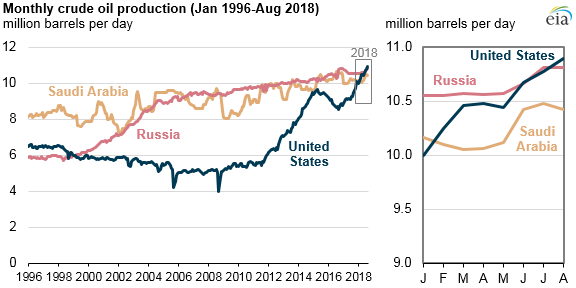
The United States likely surpassed Russia and Saudi Arabia to become
the world’s largest crude oil producer earlier this year, based on
preliminary estimates in EIA’s Short-Term Energy Outlook
(STEO). In February, U.S. crude oil production exceeded that of Saudi
Arabia for the first time in more than two decades. In June and August,
the United States surpassed Russia in crude oil production for the first
time since February 1999.
Although EIA does not publish crude oil production forecasts for
Russia and Saudi Arabia in STEO, EIA expects that U.S. crude oil
production will continue to exceed Russian and Saudi Arabian crude oil
production for the remaining months of 2018 and through 2019.
U.S. crude oil production, particularly from light sweet crude oil
grades, has rapidly increased since 2011. Much of the recent growth has
occurred in areas such as the Permian region in western Texas and
eastern New Mexico, the Federal Offshore Gulf of Mexico, and the Bakken
region in North Dakota and Montana.
The oil price decline in mid-2014 resulted in U.S. producers reducing
their costs and temporarily scaling back crude oil production. However,
after crude oil prices increased in early 2016, investment and
production began increasing later that year. By comparison, Russia and
Saudi Arabia have maintained relatively steady crude oil production
growth in recent years.
Saudi Arabia's crude oil and other liquids production data are EIA
internal estimates. Russian data mainly come from the Russian Ministry
of Oil, which publishes crude oil and condensate numbers. Other sources
used to inform these estimates include data from major producing
companies, international organizations (such as the International Energy
Agency), and industry publications, among others.
Principal contributors: Candace Dunn, Tim Hess