Search This Blog

Friday, October 30, 2020

#DataCenters Accounted For 1% of Global #Electricity Use in 2019

The energy used run the servers and keep them from overheating is considerable. Just one block of a recently built, large data center is estimated to consume up to 40 megawatts of electricity, enough to power 154 Japanese households for a month. Data centers accounted for around 1% of global electricity use in 2019, according to a recent study in the journal Science. 

See the article on Bloomberg here: https://www.bloomberg.com/news/articles/2020-10-29/japan-wants-to-take-the-heat-off-data-centers-with-the-help-of-snow

Tuesday, October 27, 2020

#Cenovus $CVE.to - #HuskyEnergy $HSE.to CAD 3.8 BN Merger Creates #Canada's 3rd Largest #Oil Producer


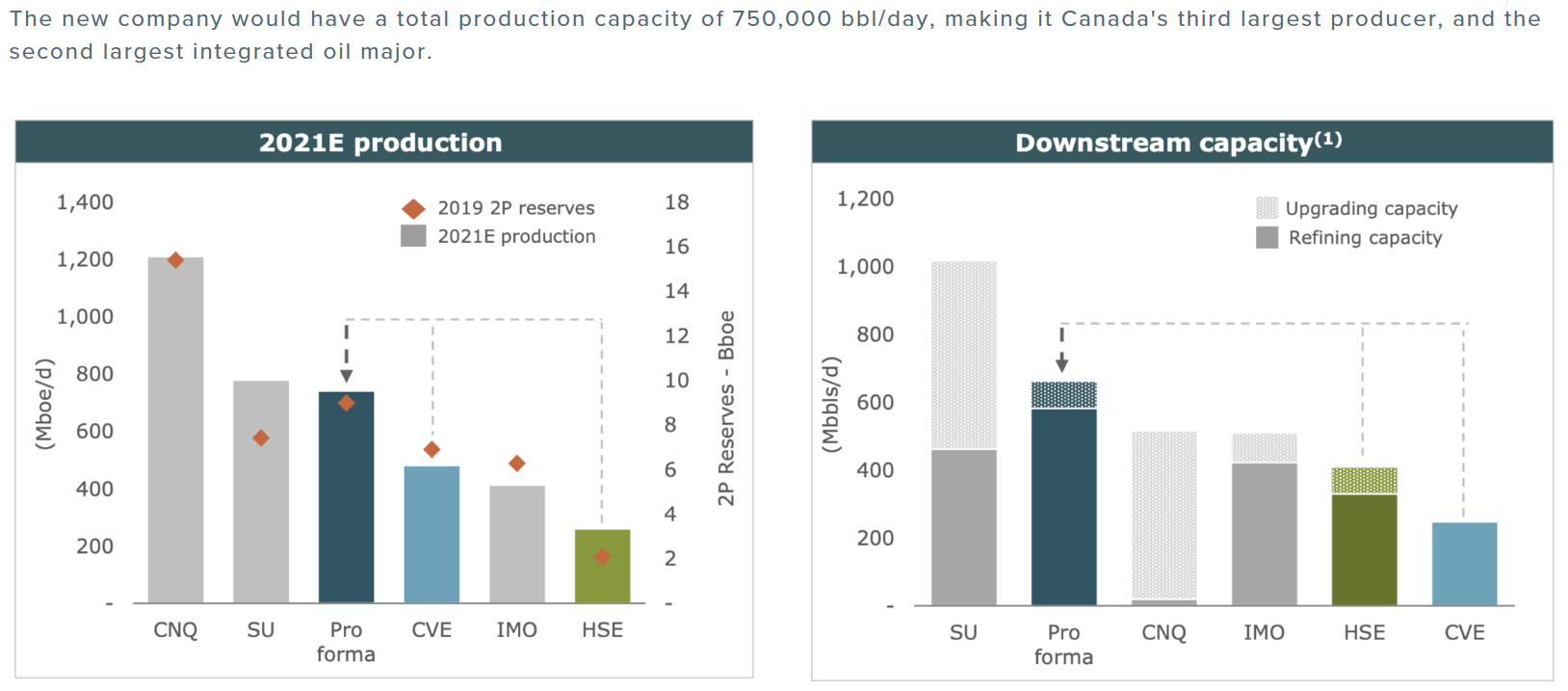
Cenovus Energy and Husky Energy agreed to a merger in an all-stock deal. The transaction will create Canada's 3rd largest oil and natural gas producer (attachment 1) and lead to CAD 1.2 Bio. in savings. The new company will be No. 2 in downstream capacity behind Suncor Energy (attachment 2).


Under the terms of the definitive agreement, Husky shareholders will receive 0.7845 of a Cenovus share plus 0.0651 of a Cenovus share purchase warrant in exchange for each Husky common share.


The shares of Cenovus Energy fell yesterday 8.4% to CAD 4.47 (attachment 3) and the shares of Husky Energy gained 12% to CAD 3.55 (attachment 4).


Buying Husky will boost Cenovus's production to about 750'000 barrels per day (b/d) from about 475'000 b/d of oil equivalent. It will gain substantial downstream assets, namely additional refinery and pipeline capacity. The Alberta Government will stop setting monthly oil production limits in December in a bid to create jobs and to use available pipeline capacity.


Cenovus' lack of refining and pipeline assets has been a major issue as Western Canadian Select (WCS) oil prices plummeted relative to West Texas Intermediate (WTI) prices.


WTI oil price trade currently at US$ 38.50 whereas Western Canadian Select prices at US$ 30.00 per barrel. Attachment 5 displays the oil prices (red-Western Canadian Select (WCS) - black West Texas Intermediate (WTI).


Attachment 6 shows the natural gas prices. The Canadian gas (AECO) is also selling at a discount to U.S. gas prices (Henry Hub).


The shares of Husky Energy have been in a strong downtrend for years as attachment 7 shows. The shares of Cenovus Energy also are in a steep downtrend (attachment 8).


Oil producers, pipeline shippers, and refineries are all struggling as there is too much oil coming out of the ground, with not nearly enough demand or places to store it.This resulted Canadian producers to sell their oil at hefty discounts to WTI, not only because of the heavier sour variety they are pumping out of the oil sands, but also because of limited pipeline capacity that moves the oil out of the Province of Alberta, the heart of the Canadian oil industry.


The Canadian ETF for oil and natural gas producing shares (XEG) CAD 4.26 shows there has been no joy to invest in Canadian oil and gas producers over the last few years (attachment 9).


We have been writing fore some time that we don't see oil prices entering into a bull market. There is very strong resistance between US$ 45 to US$ 50 per barrel (WTI prices) (Attachment 10). There is a huge amount of oil production capacity, which can come on stream if firmer oil prices persist over a shorter period of time.


__________________________________ bit.ly/MasterEnergyBlog
bit.ly/MasterEnergyRSS

Monday, October 26, 2020

84% Surge in #PDVSA Stockpiles Latest Sign of #Venezuela’s #Oil Collapse #OOTT

Latest Sign of Venezuela's Oil Collapse Is 84% Surge in Stockpiles

At this rate, #PDVSA will have to start shutting in production again, and is the latest sign that Venezuela's oil industry is on the verge of collapse.

The last time an oil tanker loaded at the Jose terminal was on Oct. 16. 

Latest Sign of Venezuela's Oil Collapse Is 84% Surge in Stockpiles

(Bloomberg) -- Venezuelan crude inventories have surged 84% over the last three weeks as the threat of U.S. sanctions ward away buyers of the nation's most important commodity. That raises the risk that state-run PDVSA will have to start shutting in production again, and is the latest sign that Venezuela's oil industry is on the verge of collapse.

The port of Jose, the main gateway of the country's oil exports, has been empty for a week as importers of Venezuelan crude including India's Reliance Industries Ltd, Spain's Repsol SA and Italy's Eni SpA skipped oil purchases this month, according to internal reports seen by Bloomberg. The three companies last month took a combined 9.7 million barrels, accounting for more than half of September's exports.

Oil stored at the Jose terminal and nearby facilities known as upgraders almost doubled to 10.6 million barrels since the end of September, reversing a 3-month decline. At these levels inventories are dangerously close to volumes that in the past have prompted the state oil company Petroleos de Venezuela SA to shut-in wells because it didn't have anywhere else to store its crude.

While U.S. sanctions have crippled Venezuela's oil export trade, so-called crude-for-diesel swaps between PDVSA and Asian and European refiners were permitted for humanitarian reasons. The Trump administration was reported in August to be considering additional measures to cut off these remaining fuel transactions. Last month, Reliance bought 12 million barrels of Canadian oil, possibly a precursor to a more permanent shift away from Venezuela.

chart, histogram: Glut © Bloomberg Glut

The Trump administration is zeroing in on the diesel swaps because it's running out of options to pressure the regime of President Nicolas Maduro. Just last month, an influential Trump administration official secretly met with a representative of Nicolas Maduro's regime in Mexico City to try to negotiate the Venezuelan leader's peaceful exit from power.

The last time an oil tanker loaded at the Jose terminal was on Oct. 16, according to ship-tracking data. There are no other vessels scheduled for the rest of the month, preliminary reports seen by Bloomberg show. That's a sharp contrast from 3 years ago, when the terminal was loading one vessel every 17 hours.

graphical user interface © via Bloomberg

Venezuela's Port of Jose sits idle for the seventh straight day

With the big European and Indian refiners sitting out of the Venezuelan market, little-known companies including Retino Maritime, Kalinin Business, Xiamen Logistic Grass and Wanneng Munay have taken over, the internal reports show. Together they loaded so far 4.6 million barrels of oil, a far cry from September, when loadings totaled 17.4 million barrels.

For more articles like this, please visit us at bloomberg.com

©2020 Bloomberg L.P.


bit.ly/MasterEnergyBlog


ShareThis

MasterEnergy News