Search This Blog

Friday, October 26, 2018

What do you want? #RenewableEnergy. When do you want it? Now!

Renewables are a public opinion juggernaut. Being against them is no longer an  option. The industry's best and only hope is to slow down the stampede a bit (and that's what they plan to try).

100 percent renewables is a wildly popular goal

The core of the industry's dilemma is captured in this slide (on the left is the industry perspective):

eei EEI

Utilities don't think it is wise or feasible to go 100 percent renewables. But the public loves it.
And I mean loves it. Check out these numbers from the opinion survey:


In our polarized age, here is something we almost all agree on: Renewable energy is awesome.
Here's the most striking slide in the presentation:

eei EEI

In case you don't feel like squinting, let me draw your attention to the fact that a majority of those surveyed (51 percent) believe that 100 percent renewables is a good idea even if it raises their energy bills by 30 percent.

The Pangea Advisors Blog: What do you want? #RenewableEnergy. When do you wa...: 100% renewable energy: the public wants it, and quick - Vox Renewables are a public opinion juggernaut. Being against them is no longer an option.

The Pangea Advisors Blog

Pangea on Twitter

Monday, October 1, 2018

Looking to create pure play #oil sands company, #Canada’s @HuskyEnergy offers 37% premium in hostile bid for @MEGenergyCorp $MEG.TO $HSE.TO

Will this mark the bottom and signal a major revival for the underperforming Canadian oil sector?

Not that long ago MEG energy,  $MEG.TO was considered a distressed company. Amazing how US$80 barrel can change things so quickly...

Investors have been focusing on high growth capital intensive Permian plays while ignoring large FCF stories in the oil sands. This may likely change soon. 

The combination of this announcement and the likely go ahead decision for the $31Bn LNG Canada project by Shell and its partners may mark the bottom and a major revival for the underperforming Canadian oil sector. 

Given the parties involved in this deal, implications and possibilities are significant for the sector. 

Still clearly cheaper to buy than to build in the oil sands. 

See more on the transaction on Bloomberg here: https://bloom.bg/2NcAxjF


Thursday, September 13, 2018

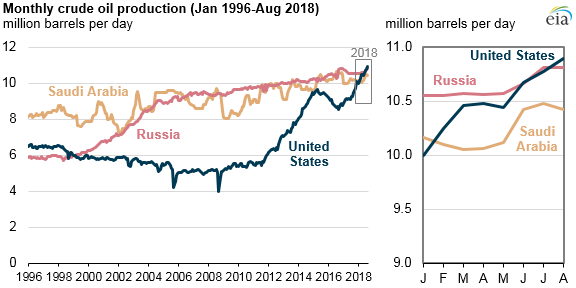
US is now the largest global crude #oil producer-EIA

monthly crude oil production

The United States is now the largest global crude oil producer - Today in Energy


September 12, 2018


The United States likely surpassed Russia and Saudi Arabia to become the world’s largest crude oil producer earlier this year, based on preliminary estimates in EIA’s Short-Term Energy Outlook (STEO). In February, U.S. crude oil production exceeded that of Saudi Arabia for the first time in more than two decades. In June and August, the United States surpassed Russia in crude oil production for the first time since February 1999.
Although EIA does not publish crude oil production forecasts for Russia and Saudi Arabia in STEO, EIA expects that U.S. crude oil production will continue to exceed Russian and Saudi Arabian crude oil production for the remaining months of 2018 and through 2019.
U.S. crude oil production, particularly from light sweet crude oil grades, has rapidly increased since 2011. Much of the recent growth has occurred in areas such as the Permian region in western Texas and eastern New Mexico, the Federal Offshore Gulf of Mexico, and the Bakken region in North Dakota and Montana.
The oil price decline in mid-2014 resulted in U.S. producers reducing their costs and temporarily scaling back crude oil production. However, after crude oil prices increased in early 2016, investment and production began increasing later that year. By comparison, Russia and Saudi Arabia have maintained relatively steady crude oil production growth in recent years.
Saudi Arabia's crude oil and other liquids production data are EIA internal estimates. Russian data mainly come from the Russian Ministry of Oil, which publishes crude oil and condensate numbers. Other sources used to inform these estimates include data from major producing companies, international organizations (such as the International Energy Agency), and industry publications, among others.
Principal contributors: Candace Dunn, Tim Hess

ShareThis

MasterEnergy News