Search This Blog

Showing posts with label IEA. Show all posts

Thursday, March 22, 2018

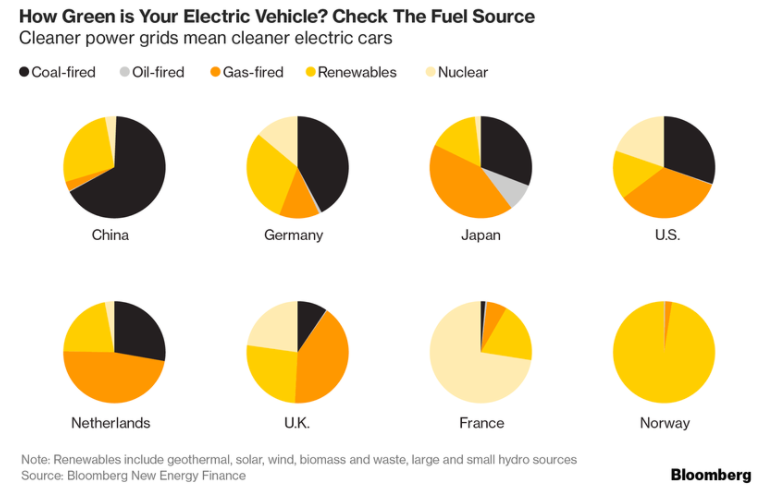
How “Green” is your #EV? Depends, says @WEF

The surprising truth behind the world's electric cars | World Economic Forum
Though electric cars are greener than conventional ones, much of their power still comes from coal.


The surprising truth behind the world's electric cars


Baojun E100 all-electric battery cars are seen while they are being charged in the parking lot in front of a Baojun NEV Experience Center store in Liuzhou, Guangxi Zhuang Autonomous Region, China, November 8, 2017. Picture taken November 8, 2017. REUTERS/Norihiko Shirouzu
Image: REUTERS/Norihiko Shirouzu

The production and sale of electric vehicles accelerated in 2016, with two million cars manufactured and over 750,000 sold globally, according to the International Energy Agency's (IEA) 2017 Global Electric Vehicle report.
And the market is expected to boom further in the coming years. The report predicts electric car stocks will range from between nine million and 20 million by 2020 and between 40 million and 70 million by 2025. Countries around the world are also attempting to ban the sale of petrol and diesel cars, and are encouraging motorists to go green.
However, electric vehicles are not emissions-free. While these vehicles obviously run on electricity, that electricity typically comes from a mix of emissions-intensive fossil fuels, nuclear energy, and power from renewables. That is, unless you live in country like Norway, which generates virtually all of its electricity from hydropower. But Norway is the exception rather than the rule.

Monday, March 5, 2018

Biggest risk to #Oil market lies most likely in #Venezuela @NickBb2211 #Guyana #OPEC #OOTT @FT

There are many-mostly political-risks out there, from Saudi pushback on #MBS' "reforms" to instability/conflict on the Korean Peninsula, but the biggest all round risk to the Oil market lies in #Venezuela, writes Nick Butler @NickBb2211. 

"What surprise event of 2018 will shift the energy market out of a complacency that is the result of steady demand matched by plentiful supplies, with the equation balanced not just by the Opec quota but also by the continuing decline in Venezuelan production.

It is hard to identify any factor within the industry that could reshape the market…Any real change will come from events in the external political environment. "
…
"to me the most likely — risk lies in Venezuela, the most unstable state within Opec. The country's inflation is beyond counting. The economy, civil society and government have broken down. The army is a caricature of corruption. President Nicolás Maduro remains in power but his position is weak. The danger is that in extremis he seeks a convenient enemy against which to unite the nation and embarrass the Venezuelan opposition. 

"The most likely target is Guyana — the subject of a long-running territorial dispute. Recently, I wrote about the new offshore oil discoveries. The beginning now of the process of development of those fields, which are due on stream by 2020, could provide an excuse for Venezuelan intervention in the disputed area east of the Essequibo river."

Read the whole piece by Nick Butler @NickBb2211 online @FT: https://www.ft.com/content/d76e9ac4-1d67-11e8-aaca-4574d7dabfb6

Wednesday, October 21, 2015

U.S. #oil output almost back down to level of last #OPEC meeting

Interesting chart from this Bloomberg article: OPEC is about to crush the US oil boom.


Key Points

Saudis oil strategy appears to be working:

1.       Oil prices remains 33% percent lower than when OPEC revealed its strategy on Nov. 27.
2.       U.S. crude production has retreated about 500,000 barrels a day from the three-decade peak reached in June to 9.1 million a day in the week to Oct. 9, according to data from the Energy Information Administration.
3.       The losses will accelerate next year with a drop of 390,000 barrels a day in annual average production to 8.86 million barrels a day, according to the EIA. OPEC's fortunes will improve as the U.S. declines, with the IEA predicting demand for the group's crude climbing to 31.1 million barrels a day next year from 29.3 million in 2014

ShareThis

MasterEnergy News