Search This Blog

Showing posts with label Batteries. Show all posts

Monday, August 31, 2020

#Chile wants to export as much green #hydrogen by 2050—$30bn worth—, as it does today #Copper.

Chile seeks to turn solar boom into green hydrogen bonanza
Financial Times 

"a green technology revolution has pushed the cost of producing solar power down 80 per cent, and renewables now make up 44 per cent of the mix in a nation no longer dependent on imported energy. 

"Chile is now hoping this will allow it to achieve a similar feat with green hydrogen, a clean alternative to fossil fuels that — unlike solar and wind energy — can be used at any time of day or night and in any weather conditions.

…

"Chile could be exporting $30bn of green hydrogen by 2050," said Juan Carlos Jobet, the country's energy minister. "That's how much copper we export today."

Read the whole article online here: https://www.ft.com/content/16481d72-1495-4b24-9c59-97ea9a856cc1
MasterEnergy


Sunday, January 27, 2019

2019 Electric Vehicles #EV’s Sales expected to go up by “only” 40%

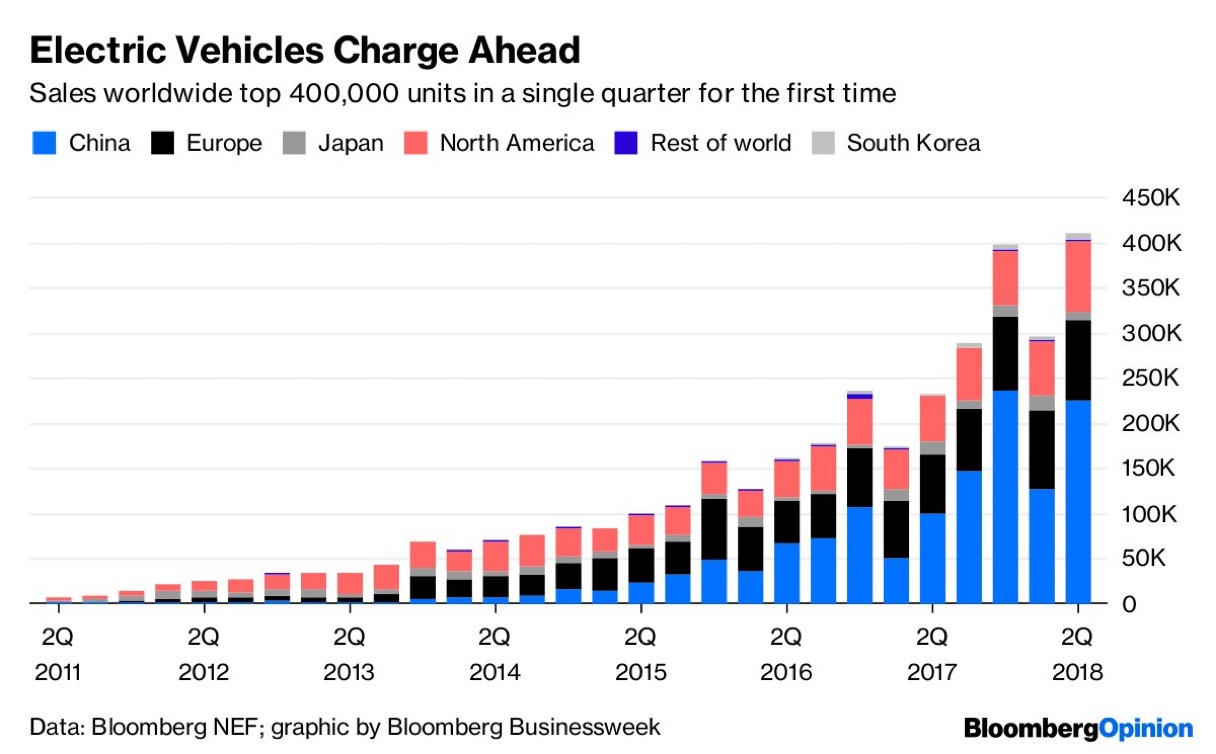
Electric vehicle sales are Charging Ahead
In 2019 Electric vehicle sales are expected to go up by “only” 40%

There are now almost 5 million passenger electric vehicles on the road globally (over 5 million including buses and other commercial vehicles). We expect another 2.6 million to be sold in 2019. This will represent around a 40% growth rate, down from the 70% growth rate in 2018. China will again lead, with some 1.5 million of those sales, representing around 57% of the global market.

Thursday, March 22, 2018

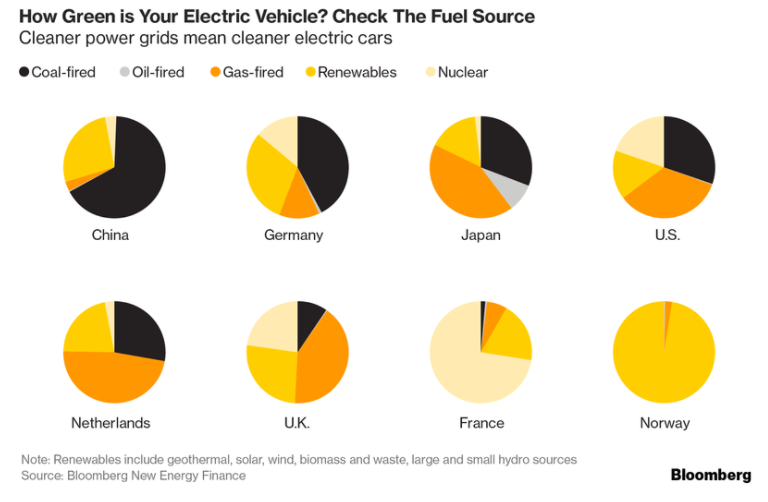
How “Green” is your #EV? Depends, says @WEF

The surprising truth behind the world's electric cars | World Economic Forum
Though electric cars are greener than conventional ones, much of their power still comes from coal.


The surprising truth behind the world's electric cars


Baojun E100 all-electric battery cars are seen while they are being charged in the parking lot in front of a Baojun NEV Experience Center store in Liuzhou, Guangxi Zhuang Autonomous Region, China, November 8, 2017. Picture taken November 8, 2017. REUTERS/Norihiko Shirouzu
Image: REUTERS/Norihiko Shirouzu

The production and sale of electric vehicles accelerated in 2016, with two million cars manufactured and over 750,000 sold globally, according to the International Energy Agency's (IEA) 2017 Global Electric Vehicle report.
And the market is expected to boom further in the coming years. The report predicts electric car stocks will range from between nine million and 20 million by 2020 and between 40 million and 70 million by 2025. Countries around the world are also attempting to ban the sale of petrol and diesel cars, and are encouraging motorists to go green.
However, electric vehicles are not emissions-free. While these vehicles obviously run on electricity, that electricity typically comes from a mix of emissions-intensive fossil fuels, nuclear energy, and power from renewables. That is, unless you live in country like Norway, which generates virtually all of its electricity from hydropower. But Norway is the exception rather than the rule.


Sunday, March 4, 2018

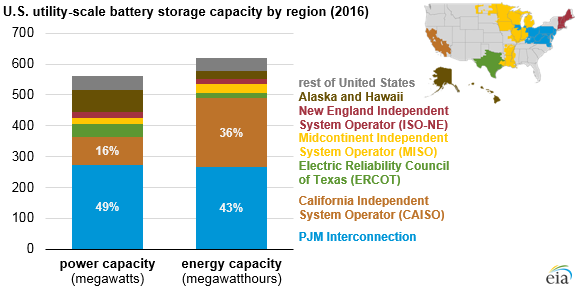
About ⅔ of utility-scale #batterystorage power capacity installed in 2016 in US is located in 2 electricity markets: #California (CAISO), & #PJMInterconnection, in all or parts of 13 eastern states & DC. @EIAgov

The design and application of utility-scale battery storage varies by region - Today in Energy - U.S. Energy Information Administration (EIA)
The design and application of utility-scale battery storage varies by region
February 28, 2018 U.S. utility-scale battery storage capacity by region, as explained in the article text

About two-thirds of utility-scale battery storage power capacity installed in 2016 in the United States is located in two electricity markets: the California Independent System Operator (CAISO), which covers much of California, and the PJM Interconnection, which covers all or parts of 13 eastern states and the District of Columbia. Utility-scale battery systems have been installed in these markets for different reasons. Utility-scale battery storage systems in California tend to serve energy-oriented applications, with smaller power capacities but longer discharge durations. Conversely, systems in PJM tend to serve power-oriented applications, with larger power capacities but shorter discharge durations.
Unlike most electricity generators, which can be characterized by their power capacity, batteries are characterized by two metrics: power capacity and energy capacity. Power capacity, measured in megawatts (MW), is the maximum instantaneous amount of power that can be produced on a continuous basis. Energy capacity, measured in megawatthours (MWh), is the total amount of energy that can be stored or discharged by the battery.

Friday, January 26, 2018

Grid cost parity is coming sooner than you think. How will #utilities react? #Renewables #batteries


Great report from @EY 

Utilities are on a countdown to reinvention

The energy industry has long known that radical transformation is coming. Revenues have been under pressure from the rise in renewables; in 2016, clean energy accounted for almost two-thirds of net new power capacity around the world.[1]

The maturing of renewable energy technologies, the proliferation of distributed energy resources, the falling cost of battery storage, and changing, more empowered consumer behavior are shifting how we produce, use, value and trade electricity.

Together these forces have put the energy sector on a path to three critical tipping points:

These dates will vary across global regions, because the trends driving change in the energy sector are different for different markets. But what is certain across all is that change is coming sooner than most of us previously expected. 
Grid cost parity is 2021 
  1. Tipping point 1 – when off-grid energy reaches cost and performance parity with grid-delivered energy – will arrive as early as 2021 in Oceania.
  2. Tipping point 2 – when electric vehicles (EVs) reach price and performance parity with combustion engine vehicles – will follow from 2025 across the globe. 
  3. And tipping point 3 – when the cost of transporting electricity exceeds the cost of generating and storing it locally – will hit the US Northeast region first in 2039.
See the full report here:

https://betterworkingworld.ey.com/digital/energycountdownclock


ShareThis

MasterEnergy News