Search This Blog

Showing posts with label OPEC. Show all posts

Monday, October 27, 2025

New Russian Oil Co. Sanctions

On Wednesday night, the US Department of the Treasury's Office of Foreign Assets Control hit Russia's two largest oil exporters, Rosneft PJSC and Lukoil PJSC, with sanctions. The move raises the stakes for buyers of their barrels, principally refiners in ChinaIndia and Turkey.

Rosneft PJSC and Lukoil PJSC, together with Surgutneftegas PJSC and Gazprom Neft PJSC, blacklisted in Januaryaccounted for almost 70% of Russia's crude exports — around 3.1 million barrels a day — in the first half of the year.

If just half the Russian barrels covered by sanctions are curtailed, that could push the global oil market next year from a surplus of 700,000 barrels a day into a deficit, according to Bloomberg calculations using forecasts from the Organization of the Petroleum Exporting Countries. 

Thursday, September 9, 2021

#Nigeria enacts long-delayed law cutting taxes on #energy companies in its push to almost triple production in just over three years!?!

Nigeria finally enacted a long-delayed law cutting taxes levied on energy companies to more globally competitive levels, in its push to increase Oil production more than 2X by 2025 (!). 

Something that is quite doubtful that it could be achieved: To almost triple production in just over three years!?! 

Production royalties will now range from 5% to 15%, depending on where fields are located, down from the previous range of 7.5% to 20%.  

Nigeria currently pumps about 1.5 million barrels of oil a day. That's down from a peak of 2.5 million in 2005. 

The decline is attributed to a lack of investment in new wells, oil theft and its adherence to quotas set by OPEC.

The country attracted just 4% of the $70 billion committed to Africa's oil and gas sector from 2015 to 2019, partly due to uncertainty over its regulatory environment, according to accounting firm KPMG. 

President Muhammadu Buhari's administration is banking on an influx of capital to boost production to 4 million barrels a day by 2025. Any such increase could cause heat with other members of OPEC+, which limits supply to keep prices up. —And is quite doubtful it could be achieved in just over three years!?! 

See the whole article on Bloomberg here: Nigeria Races to Extract Its Oil Before It's Too Late -https://www.bloomberg.com/news/articles/2021-09-02/nigeria-races-to-extract-its-oil-before-it-s-too-late-quicktake?

Wednesday, February 24, 2021

Sheik #Yamani, Legendary #Oil Man, dies at 90, RIP

Image

Sheikh Ahmed Zaki Yamani, has died at age 90.

Yamani served as Saudi Arabia's Oil Minister from 1962 until 1986, when he was dismissed by Saudi King Fahd over differing opinions on the Kingdom's oil policies.

When Yamani began his role as oil minister in 1962, the United States was the leading oil producer, with Saudi Arabia producing less than 2 million barrels per day. And Exxon and Chevron had control of most of the oil in Saudi Arabia. But that quickly changed as Saudi Arabia moved to nationalize its oil industry. Saudi Arabia's oil production quickly reached 10 million bpd during Yamani's tenure.

Chart courtesy of Dr. Anas Alhajji

See the whole article on Oilprice.com here:

https://oilprice.com/Latest-Energy-News/World-News/Saudi-Arabias-Longest-Serving-Oil-Minister-Dies-At-90.html

__________________________________ 

Monday, April 13, 2020

#OPEC+ #Oil Cuts Deal: @BMO Sees Best outcome of Prices Stabilizing between $20-30 as demand rebuilds


From BMO:

 CONCLUSION:. On the positive side, the agreement avoids a price collapse as it reduces the risk of filling up the global storage capacity completely and most importantly it ends the price war between Russia and Saudi Arabia.  Our research team expects the price of oil to remain between $20 and $30 through June while the market assesses the compliance and more importantly the potential rebound in demand at some point. As of this morning, the market reaction has been somewhat muted with Brent and WTI relatively unchanged.

1- TOTAL CUTS OF 13.4Mb/d if you had OPEC at 6.1M b/d, OPEC+ members mostly Russia at 3.6Mb/d and G-20 cuts monastery US/Canada/Brazil at 3.7Mb/d. The cuts are focused on the May-June period then they go down to 8M b/d for July-dec.

2- AVOID PRICE COLLAPSE DUE TO LACK OF STORAGE- Demand destruction is estimated at 17Mb/d for 2Q ( compared to a 13.4M b/d cut but an actual cut from the March level of ONLY 7Mb/d for OPEC+ members). So this means inventories will go up by about 984M barrels versus a total storage capacity including floating storage left of 1.2 billion barrels.

3- END OF THE PRICE WAR- probably the most positive is all this is the end of the price war between Russia and Saudi Arabia

4- CUTS BY THE G-20? US/Canada/Brazil but allows Norway are talking about cutting 3.7M b/d of supply but it is not very clear how. It will  be mostly through Strategic Petroleum Reserves ( SPR) purchases, shut-ins and natural declines.

5- THE TEXAS RAILROAD COMMISSION ( RRC) meets tomorrow Tuesday to discuss production cuts. Based on recent discussions we are doubtful a serious official cut will come out of the US as most of the large producers like Exxon and Chevron have come against it.

6- IDEAL PRICE- we continue to think that $40 WTI is where the Saudis and the Russians want to oil price which is enough to kill US Shale's economics while helping the local budgets of each closer to balance.
 Living on the Edge: Historic Deal With a Lot of Unknowns

Oil & Gas

IN Fact

Living on the Edge: Historic Deal With a Lot of Unknowns

Randy Ollenberger • Oil & Gas
(403) 515-1502
Phillip Jungwirth, CFA • Oil & Gas
(303) 436-1127

Bottom Line:

OPEC+ has reached an agreement to reduce production by 9.7 million b/d in May and June and roughly six million over the balance of the year. The G20 group acknowledged the need to stabilize oil markets and has reportedly agreed to reduce production by 3.7 million b/d. The OPEC+ cut (if adhered to) plus expected shut-in production due to low oil prices could be just enough to keep inventories from breaching capacity. We expect crude oil prices to trade in a $20-30/bbl range through May as the market waits to see if the production cuts materialize and are large enough to stave off disaster.

Key Points

OPEC+ capitulates. OPEC and its non-OPEC partners have agreed to reduce production by 9.7 million b/d in May and June and by roughly six million b/d for the remainder of the year. The baseline for the determination of production levels is October 2018 except for Saudi Arabia and Russia, which have baselines of 11 million b/d. The group will meet again on June 10 to determine if additional action is required.

No commitments but uneconomic shut-ins elsewhere. The broader G20 group did not explicitly commit to any reductions in supply but acknowledged the need to stabilize oil markets and has reportedly agreed to reduce supply by 3.7 million b/d through declines and shut-in of uneconomic production. The OPEC+ cuts are not contingent on commitments from the U.S. and others to reduce supply. We anticipate a drop in non-OPEC production of 1.8 million b/d in the second quarter and growing over the balance of the year due to the drop in activity levels.

Level of demand destruction unknown. We believe that global oil demand could be down more than 17 million b/d year over year in the second quarter to roughly 82 million b/d, which would represent the lowest level of demand since 2004. Taking the OPEC+ cuts into consideration we anticipate a year-over-year decline in production of 7 million to 92.8 million b/d, which implies a build of approximately 984 million barrels. We estimate remaining available global storage capacity (including floating storage) is roughly 1.2 billion barrels. While this means there could be adequate storage room there is not much room for error.

Pricing in uncertainty. We expect crude oil prices to remain relatively weak through April and May as the market assesses the risk that the level of demand destruction could be higher than expected, leading to the possibility that there is not enough storage available. We also expect regional dislocations where storage fills up leading to wider price differentials in some markets.

View Comment >


Nothing in this e-mail shall constitute a personal recommendation unless explicitly provided.

BMO Capital Markets archives and monitors outgoing and incoming e-mail. The contents of this email, including any attachments, are confidential to the intended recipient and any unauthorized use or disclosure is prohibited. If you are not the intended recipient, do not re-send, copy or use this e-mail. Please also contact the sender immediately and delete this e-mail in its entirety. Privilege is not waived by reason of mistaken delivery to you. This email may be produced at the request of regulators or in connection with litigation. BMO Capital Markets accepts no liability for any errors or omissions arising as a result of transmission. Unless otherwise stated, opinions expressed in this email are those of the author and are not endorsed by BMO Capital Markets.

This message does not create or change any contract.

This email has been sent from Bank of Montreal Europe plc (Registered No. 255687), which operates under the trade name of "BMO Capital Markets" and is registered in Ireland with its registered address as 6th Floor, 2 Harbourmaster Place, IFSC, Dublin 1. Bank of Montreal Europe plc is authorised and regulated by the Central Bank of Ireland.

Monday, March 9, 2020

#Oil: Energy companies feel the pain of #Saudi Arabia’s price war

A graphic with no description
Energy companies feel the pain of Saudi Arabia's price war
'This is the financial crisis for oil — except the producers are not too big to fail'

From the shale fields of Texas to deepwater projects in the North Sea, the price war launched by Russia and Saudi Arabia sent shockwaves across the entire energy industry and triggered the biggest sell-off since the global financial crisis.  

It has left some companies searching for strategies to protect profits and keep paying dividends. Others are fighting for survival. 

"The price collapse could be the trigger for a new phase of deep industry restructuring — one that rivals the changes seen in the late-1990s," said Tom Ellacott of the consultancy Wood Mackenzie. "Sustained prices below $40 a barrel would trigger a new wave of brutal cost-cutting. More highly-leveraged players will be forced to make the deepest cuts to stave off bankruptcy." 

Nowhere is that more true than in the shale industry, which helped end US dependence on Middle Eastern oil.


______________________________
MasterEnergy
@MasterEnergyRSS


#Oil Market Update March 9 2PM EDT #OOTT


___________________________

Friday, March 6, 2020

US crude #Oil exports increased 45% to ~3MM b/d in 2019 @EIA_gov #OOTT #TWIP

Figure 1. Annual U.S. crude oil exports (1920-2019)
U.S. crude oil exports averaged 2.98 million barrels per day (b/d) in 2019, an increase of 930,000 b/d (45%) from 2018 (Figure 1). 
The number of destinations for U.S. crude oil exports increased from 41 to 44, and Canada continued to receive the largest share (15%, or 459,000 b/d), followed by South Korea (14%, or 426,000 b/d). U.S. crude oil exports to China, the third-largest export destination in 2018, fell by nearly 100,000 b/d to average 133,000 b/d in 2019. Decreased U.S. crude oil exports to China were more than offset by increases to other destinations, resulting in shifting trade patterns. The growth in U.S. crude oil exports was driven by increasing U.S. crude oil production, expanding domestic infrastructure, and increased global demand for light, low-sulfur crude oils.

Thursday, March 5, 2020

#OPEC Ministers agree to cut #Oil production by 1.5MM bopd


Closed session talks continue but headlines leaking out of Vienna from 'delegates' per Bloomberg,confirming the high end scenario floated yesterday morning. Sounds like OPEC (ie Saudi) is going it alone without additional support from Russia after Novak refused to support additional cuts at the JMMC meeting yesterday.

Brent up 70c on the news and +60bps on the day, not exactly a screaming response but step in the right direction. Still waiting on additional details around duration (assume 3M to start) and how many physical barrels 1.5MM translates to given SA already under producing by 0.4MM but combined with 1MM outage from Libya a 1.5MM incremental cut should help to offset a large amount of the China/OECD demand losses, which some estimate to be over 3-3.5MM in 1Q20.

Friday, February 28, 2020

@Vitol sees US #oil output peaking at 14MM bpd in next few years #Shale #OOTT

Vitol sees U.S. oil output peaking at 14 million bpd in next few years: CEO

Thursday, 27 February 2020 | 20:00
Trading house Vitol sees U.S. oil production peaking at around 14 million barrels per day in the next few years, its chief executive told the IP Week. 
"Shale is a very different industry. It takes a great deal to maintain pressure. It takes some 20,000 new wells every year to stand still at current production levels so we have oil production peaking in the new few years because it takes so much operationally just to maintain levels," Vitol CEO Russell Hardy said.
"So that shifts a little of power back to OPEC and OPEC+ but I don't think anyone can afford to be complacent about that."
Source: Reuters (Reporting by Julia Payne; editing by Jason Neely)


http://www.bunkerportsnews.com/News.aspx?ElementID=7721cc06-24bb-4355-8375-fee1ab4bcf7a

________________________

Sunday, February 16, 2020

#PDVSA having hard time finding buyers for 80% of February crude #Oil production

PDVSA having hard time finding buyers for 677,000 b/d of February crude | S&P Global Platts
"For February, there is 661,000 b/d of crude that has no takers. Also, PVDSA is offering to pay debts with crude to creditors but there are no interested parties," the official added.
PDVSA has offered deep price discounts for its crude, and flexible loading windows of more than 30 days  ...
The volume available for sale represents 80% of the 850,000 b/d total crude production estimated by PDVSA for February  


Highlights


Caracas, Venezuela — Venezuela's state owned PDVSA has 677,000 b/d of crude available to sell for February, but no buyers because of US sanctions, according to a company official.
"The climbing of US sanctions against the Nicolas Maduro government alienated the few clients that were still daring to enter Venezuelan ports," said a PDVSA official, who spoke on condition of anonymity.
"For February, there is 661,000 b/d of crude that has no takers. Also, PVDSA is offering to pay debts with crude to creditors but there are no interested parties," the official added.

Friday, October 25, 2019

Which Companies Account for ⅓ of World’s Cumulative #CarbonEmissions since 1965?

Big Oil, of course.


Since 1965, over ⅓ of the world's cumulative carbon emissions can be traced back to just 20 fossil fuel companies. 

Source: Visual Capitalist

Aramco's operations, Number 1 on the list, have resulted in 59,262 MtCO₂ein carbon emissions since 1965. To put that into perspective, this total is more than six times China's emissions in 2017 alone (9,838 MtCO₂e).

Read More Here on Visual Capitalist: https://www.visualcapitalist.com/companies-carbon-emissions/


Wednesday, April 3, 2019

As #Saudi Arabia #Aramco's largest #Oil field, #Ghawar's surprisingly low production capacity figure is the stand-out of the report

The Biggest Saudi Oil Field Is Fading Faster Than Anyone Guessed

By Javier Blas

It was a state secret and the source of a kingdom's riches. It was so important that U.S. military planners once debated how to seize it by force. For oil traders, it was a source of endless speculation.
Now the market finally knows: Ghawar in Saudi Arabia, the world's largest conventional oil field, can produce a lot less than almost anyone believed.

When Saudi Aramco on Monday published its first ever profit figures since its nationalization nearly 40 years ago, it also lifted the veil of secrecy around its mega oil fields. The company's bond prospectus revealed that Ghawar is able to pump a maximum of 3.8 million barrels a day -- well below the more than 5 million that had become conventional wisdom in the market.

"As Saudi's largest field, a surprisingly low production capacity figure from Ghawar is the stand-out of the report," said Virendra Chauhan, head of upstream at consultant Energy Aspects Ltd. in Singapore.

King of Oil


The Energy Information Administration, a U.S. government body that provides statistical information and often is used as a benchmark by the oil market, listed Ghawar's production capacity at 5.8 million barrels a day in 2017. Aramco, in a presentation in Washington in 2004 when it tried to debunk the "peak oil" supply theories of the late U.S. oil banker Matt Simmons, also said the field was pumping more than 5 million barrels a day, and had been doing so since at least the previous decade.

...

The prospectus offered no information about why Ghawar can produce today a quarter less than 15 years ago -- a significant reduction for any oil field. The report also didn't say whether capacity would continue to decline at a similar rate in the future.

...

The 470-page bond prospectus confirms that Saudi Aramco is able to pump a maximum of 12 million barrels a day -- as Riyadh has said for several years. The kingdom has access to another 500,000 barrels a day of output capacity in the so-called neutral zone shared with Kuwait. That area isn't producing anything now due a political dispute with its neighbor.

While the prospectus confirmed the overall maximum production capacity, the split among fields is different to what the market had assumed. As a policy, Saudi Arabia keeps about 1 million to 2 million barrels a day of its capacity in reserve, using it only during wars, disruptions elsewhere or unusually strong demand. Saudi Arabia briefly pumped a record of more than 11 million barrels a day in late 2018.

...

Costly Strategy

For Aramco, that's a significant cost, as it has invested billions of dollars into facilities that aren't regularly used. However, the company said the ability to tap its spare capacity also allows it to profit handsomely at times of market tightness, providing an extra $35.5 billion in revenue from 2013 to 2018. Last year, Saudi Energy Minister Khalid Al-Falih said maintaining this supply buffer costs about $2 billion a year.

Aramco also disclosed reserves at its top-five fields, revealing that some of them have shorter lifespans than previously thought. Ghawar, for example, has 48.2 billion barrels of oil left, which would last another 34 years at the maximum rate of production. Nonetheless, companies are often able to boost the reserves over time by deploying new techniques or technology.

In total, the kingdom has 226 billion barrels of reserves, enough for another 52 years of production at the maximum capacity of 12 million barrels a day.

The Saudis also told the world that their fields are aging better than expected, with "low depletion rates of 1 percent to 2 percent per year," slower than the 5 percent decline some analysts suspected.

Read the whole article here:  The Biggest Saudi Oil Field Is Fading Faster Than Anyone Guessed

______________________________

Thursday, March 22, 2018

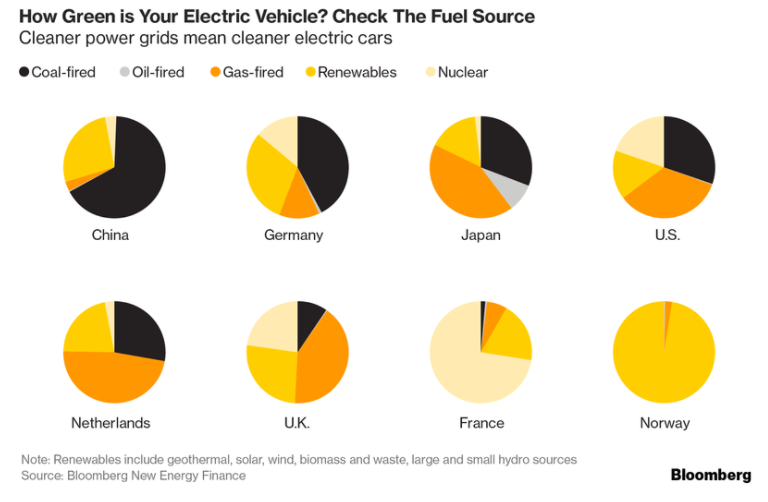
How “Green” is your #EV? Depends, says @WEF

The surprising truth behind the world's electric cars | World Economic Forum
Though electric cars are greener than conventional ones, much of their power still comes from coal.


The surprising truth behind the world's electric cars


Baojun E100 all-electric battery cars are seen while they are being charged in the parking lot in front of a Baojun NEV Experience Center store in Liuzhou, Guangxi Zhuang Autonomous Region, China, November 8, 2017. Picture taken November 8, 2017. REUTERS/Norihiko Shirouzu
Image: REUTERS/Norihiko Shirouzu

The production and sale of electric vehicles accelerated in 2016, with two million cars manufactured and over 750,000 sold globally, according to the International Energy Agency's (IEA) 2017 Global Electric Vehicle report.
And the market is expected to boom further in the coming years. The report predicts electric car stocks will range from between nine million and 20 million by 2020 and between 40 million and 70 million by 2025. Countries around the world are also attempting to ban the sale of petrol and diesel cars, and are encouraging motorists to go green.
However, electric vehicles are not emissions-free. While these vehicles obviously run on electricity, that electricity typically comes from a mix of emissions-intensive fossil fuels, nuclear energy, and power from renewables. That is, unless you live in country like Norway, which generates virtually all of its electricity from hydropower. But Norway is the exception rather than the rule.


Monday, March 5, 2018

Biggest risk to #Oil market lies most likely in #Venezuela @NickBb2211 #Guyana #OPEC #OOTT @FT

There are many-mostly political-risks out there, from Saudi pushback on #MBS' "reforms" to instability/conflict on the Korean Peninsula, but the biggest all round risk to the Oil market lies in #Venezuela, writes Nick Butler @NickBb2211. 

"What surprise event of 2018 will shift the energy market out of a complacency that is the result of steady demand matched by plentiful supplies, with the equation balanced not just by the Opec quota but also by the continuing decline in Venezuelan production.

It is hard to identify any factor within the industry that could reshape the market…Any real change will come from events in the external political environment. "
"to me the most likely — risk lies in Venezuela, the most unstable state within Opec. The country's inflation is beyond counting. The economy, civil society and government have broken down. The army is a caricature of corruption. President Nicolás Maduro remains in power but his position is weak. The danger is that in extremis he seeks a convenient enemy against which to unite the nation and embarrass the Venezuelan opposition. 

"The most likely target is Guyana — the subject of a long-running territorial dispute. Recently, I wrote about the new offshore oil discoveries. The beginning now of the process of development of those fields, which are due on stream by 2020, could provide an excuse for Venezuelan intervention in the disputed area east of the Essequibo river."

Read the whole piece by Nick Butler @NickBb2211 online @FT: https://www.ft.com/content/d76e9ac4-1d67-11e8-aaca-4574d7dabfb6

Wednesday, February 14, 2018

#Venezuela #Oil Production #OOTT

Venezuela: Hide and Seek with Genscape's Flare-Signature Intelligence | www.genscape.com

Venezuela: Hide and Seek with Genscape's Flare-Signature Intelligence


Devin Geoghegan, Global Director, Supply & Demand Analytics
February 13, 2018

Deciphering Venezuelan oil is akin to searching for a rusted penny at night in a muddy pond with only starlight to illuminate – you are better off relying on a metal detector. To provide transparency into the current situation, Genscape decided to deploy its proprietary flare signature methodology on Venezuelan oil production after having had success with Libya. As discussed below, we believe the work shines needed light in near-real time on Petróleos de Venezuela S.A's ("PDVSA") oil and other liquids production. Notably, Genscape's work disagrees with and sometimes front-runs benchmark data at key inflection points.
As with Libya, Genscape built the monitor using government, regulatory, and company data by field-area, and we mapped it to our proprietary flare signature methodology across time. The results are showcased in Figure 1 below along with a few key annotations.

Genscape's High-Frequency Oil Production Monitor
Figure 1: The blue line represents Genscape's daily total liquids production estimate; the black line is the rolling five-day average of the estimated production; the red, green, and yellow lines represent the IEA, PDVSA, and OPEC, respectively. Note: given that PDVSA and OPEC only provide oil production, their time series has been modified to include condensate and NGL volumes. Click to enlarge

As shown in Figure 1 above, the monitor markedly disagreed with the benchmark data five times since April 2013. Twice it is lower and thrice higher. During late 2013 through Q3 2015, the monitor did not detect signal degradation to corroborated production declines shown by the IEA and OPEC. By Q3 2015, the three time series (Genscape's Monitor, the IEA, and OPEC) converged as production estimates by the IEA and OPEC rose slightly and the monitor detected signal erosion. However, in Q4 2015 the monitor detected significant signal decay (followed by a brief recovery) and indicated that production was running into problems several months before the IEA and OPEC reflected a new period of sharp declines. 
Subsequently, the monitor and the benchmarks moved in-line with each other until May 2017 when the monitor again detected significant signal declines. Part of these declines were the cessation of flare signatures from facilities in the El Salto and San Cristobal field-areas, which indicated production was again facing substantial headwinds. From that point through November 2017, the monitor showed production falling faster than the benchmarks.

Monday, October 24, 2016

The sorry state of #Venezuela's #oil fields


The decrepit state of aging oil fields is a crucial reason why Venezuela’s output is falling faster than that of any other major oil producer bar insurgency-riven Nigeria, despite having the world’s largest reserves.

Great article from Anatoly Kurmanaev on the sorry state of Venezuela's oil fields.

Venezuelan Oil Is Largely Staying in Ground or Going Up in Smoke

Anatoly Kurmanaev | Photographs by Miguel Gutiérrez for The Wall Street Journal

PUNTA DE MATA, Venezuela—This fading oil town has an eerie glow at night, illuminated by dozens of oil wells burning off precious oil and gas for lack of functioning equipment to process it.
...

Making matters worse, for every barrel of light crude burned off at Punta de Mata’s wells, Venezuela needs to spend dollars importing a barrel of diluent to mix with the very heavy oil produced in the country’s south.

“This is pure mismanagement,” said Carlos Bellorin, an oil analyst at IHS Inc. in London. “There’s no other rational explanation for such waste.”

The decrepid state of aging fields like Punta de Mata, which provide the bulk of Venezuela’s revenues, is a crucial reason why the country’s oil output is falling faster than that of any other major oil producer bar insurgency-riven Nigeria.

Venezuelan crude production shrank 11% to 2.3 million barrels a day in a year to September, according to government figures, and the consulting firm Medley & Associates expects the fall to accelerate in the next 12 months.

...

Overall, the number of working oil rigs in Venezuela declined by a quarter in the 12 months to September, according to Houston-based oil-field-service company Baker Hughes Inc. There are now more rigs drilling in Oman, where proven reserves are just 1.7% of Venezuela’s.

“I don’t think this government will be able to stabilize production even if the oil prices start to rise,” said Luisa Palacios, Medley’s Venezuela analyst....

Oilmen in Punta de Mata, once Venezuela’s major oil-producing hub, blame Venezuela’s production decline on government expropriations, corruption and collapsing wages that left state oil company Petróleos de Venezuela SA, known as PdVSA, increasingly hobbled.

The international oil service companies including U.S.-based Schlumberger Ltd., Halliburton Co. and Baker Hughes, which once drilled Punta de Mata’s wells and managed the flow of associated gas, are almost all gone, either squeezed out by billions of dollars of unpaid invoices or their local assets expropriated by the government.

As foreign companies began to idle drilling rigs and skilled workers left, output at the Northern Monagas Basin, which includes Punta de Mata, plunged two-thirds in the past decade, the steepest decline in the country, according to PdVSA’s regional managers.

Hit by the cash crunch, PdVSA is now trying to postpone $5-billion-worth of maturing bonds for three years, a move rating agency Standard & Poor’s said is “tantamount to default.”

PdVSA has already practically defaulted on its domestic debts. The company owed $19 billion to contractors—who provide everything from rigs to lunches—at the end of last year, according to its latest annual report.

After writing off $500 million in the country, Schlumberger, the world’s biggest oil-services provider, began to wind down operations at mature fields in June. It fired hundreds of workers, mothballed some rigs and said it would only work with PdVSA when prepaid in cash.

“Schlumberger just threw in the towel,” said Hector Navarro, a PdVSA production manager in Northern Monagas. “They left us to fend for ourselves.”

Earlier this year, a services subsidiary of Italian oil giant Eni SpA, called Saipem, removed its rigs from Northern Monagas and dismissed about 300 workers, according to the national oil union FUTPV. Saipem’s finance chief told investors in July that the company had “reduced almost to zero our operating exposure to Venezuela.”

As of this year, Halliburton will only drill for PdVSA when it is partnered with a foreign shareholder and has a better chance at getting paid, according to two company engineers in Venezuela.
Read the article online here:Venezuelan Oil Is Largely Staying in Ground or Going Up in Smoke - WSJ

Wednesday, October 21, 2015

U.S. #oil output almost back down to level of last #OPEC meeting

Interesting chart from this Bloomberg article: OPEC is about to crush the US oil boom.


Key Points

Saudis oil strategy appears to be working:

1.       Oil prices remains 33% percent lower than when OPEC revealed its strategy on Nov. 27.
2.       U.S. crude production has retreated about 500,000 barrels a day from the three-decade peak reached in June to 9.1 million a day in the week to Oct. 9, according to data from the Energy Information Administration.
3.       The losses will accelerate next year with a drop of 390,000 barrels a day in annual average production to 8.86 million barrels a day, according to the EIA. OPEC's fortunes will improve as the U.S. declines, with the IEA predicting demand for the group's crude climbing to 31.1 million barrels a day next year from 29.3 million in 2014

ShareThis

MasterEnergy News